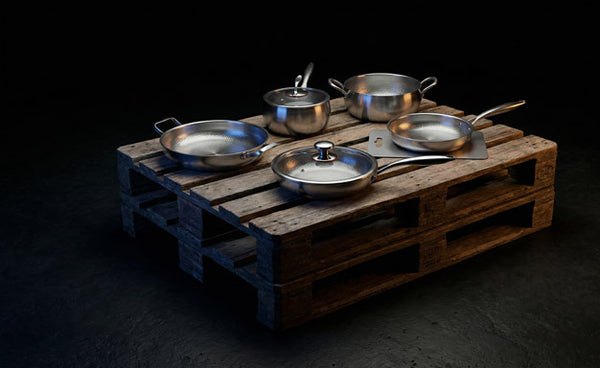
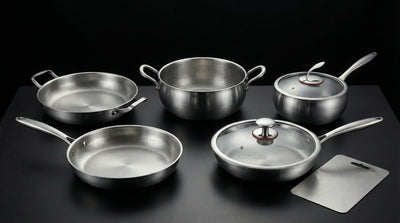
The Top 5 Titanium Pans of 2026 — And the One We Can No Longer Cook Without
“Titanium” pans are everywhere right now — butmost aren’t titanium at all.We tested the most popular options so you don’t waste money on a coated aluminium pan with a marketing word printed on the box.
Kevin
Owner · Okura Cookware
Published June 18, 2026
Why people are switching to titanium
If you landed here after a titanium pan let you down, you’re in good company.
The rush toward titanium is real — because more people are asking a simple question: what is my pan leaving in my food? With most cookware, the answer isn’t pretty:
✗Non-stick (PTFE / Teflon) — sheds PFAS “forever chemicals” into your food
✗Ceramic-coated — leaches binders & heavy metals as it wears
✗Stainless steel — transfers trace nickel & chromium into food
✗Aluminium — leaches aluminium into acidic dishes
✗Cast iron — leaches iron into your food over time
Every one of them puts something you didn’t choose onto your plate.
Titanium promises the opposite: a surface that’s inert and food-safe — the same metal surgeons trust inside the human body — naturally tough, and built to outlive every coated pan before it.
So the demand is real, and the reasons are good. There’s just one catch: most pans wearing the titanium label were never titanium in the first place. And that’s exactly why so many people end up disappointed.
I’ve been there myself. For fifteen years I cycled through cookware that was supposed to be “the one” — cast iron, carbon steel, ceramic, and lately a wave of pans calling themselves titanium. Most of them peeled, stuck, or wore out within months.
Here’s what almost no one tells you: the vast majority of “titanium” pans are just aluminium or steel with a sprayed-on coating — with a fraction of a percent of titanium dust mixed in, enough to legally print the word on the box.
When that coating peels, people blame titanium. But there was never any real titanium touching their food.
Worn coating — food sticks and burns on
Titanium surface — clean release
WHY OKURA?
Not All ‘Titanium’ Pans Are Created Equal
We compare Okura’s titanium pans with so-called ‘titanium’ pans from other sellers.
TOP PICK
OKURA
Titanium Pan
Titanix Pro*
Non-Stick Pan
ChefCore Hybrid*
Titanium Infused
EverCook Ceramic*
Ceramic Pan
◇PFAS-Free
✓
✓
✓
✓
◇Induction Ready
✓
✓
✓
×
◇Oven Safe
High-heat capable
Varies by product
Varies by product
Varies by product
◇Durable Surface
✓Built for long-term use
×Coating may wear over time
×Coating may degrade over time
×Coating may lose release over time
◇Real Titanium Food-Contact Surface
✓Titanium cooking surface
×Coated surface over aluminium
×Titanium-infused coating
×Ceramic coating over aluminium
◇Coating Type
None — no sprayed-on coating
Synthetic non-stick coating
Titanium-infused coating
Ceramic coating
◇Long-Term Value
Built for long-term use
Coating may require replacement
Coating may require replacement
Coating may require replacement
*Illustrative competitor names used to explain common pan constructions; they are not real brands.
A real titanium pan has no coating at all. Nothing to peel, nothing to replace — and a surface that gets better with every cook.
To separate the real thing from the marketing, we ranked the most popular options on material, non-stick performance, durability, and real-world results. Here’s what we found.
⚠ Beware the “Closing Down / Retirement Sale” trap
Many fake “titanium” shops run a “Closing Down” or “Retirement Sale” countdown to rush you. They’re throwaway pop-ups —no company, no warranty— back next week under a new name.
How we ranked these pans
Not all “titanium” pans are the same — in fact, most aren’t even the same material. So we focused on the four things that actually decide how a pan cooks and how long it lasts.
Real Material — Is it solid titanium, or aluminium/steel with a titanium-infused coating? The base metal decides everything else.
Non-Stick Without Coating — Does food release because of the metal itself, or a synthetic layer that eventually wears off?
Heat & Durability — Even heat with no hot spots, and a surface that survives metal utensils and years of daily use.
Real-World Results — Do people still love it months later, or does it end up in a drawer once the coating fades?
Surface types, side by side
Before the pans, the material question in one table. This is the part most listings leave out:
Surface type
What touches food
Typical failure mode
PFAS
Titanium surface, clad
Bonded titanium metal
Discolours; no layer to lose
None
PTFE / Teflon
Fluoropolymer coating
Scratches, flakes, loses release
Yes, PTFE is a PFAS
Ceramic (sol-gel)
Silica-based coating
Release fades, often within months
Usually none
"Titanium-infused"
Coating with Ti particles
Same as its base coating
Depends on binder
Bare stainless
Stainless steel
None, but sticks without technique
None
How our pans are actually built
Three bonded layers. Thecooking surface is titanium— that is the only layer your food meets. Beneath it, analuminium corespreads heat evenly and quickly. Outside,magnetic stainless steelfor strength and induction compatibility. Every clad pan has an aluminium core; that is how you get even heat. The difference is whether the food-contact layer is a metal or a spray.
OKURA earned the #1 spot by a wide margin — because it’s the only pan we tested that is made from solid titanium, with no coating at all.
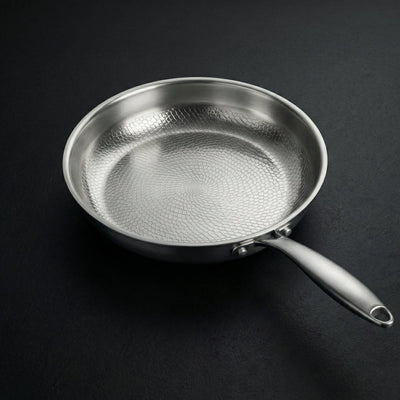
The non-stick effect doesn’t come from a sprayed layer that wears off. It comes from the hammered, dimpled surface of the metal itself, which lifts food up off the contact points.
During testing, eggs slid across the surface with barely a teaspoon of oil. A metal whisk left no mark. Heat spread evenly edge-to-edge, with no hot centre.
And after weeks of use, the surface took on a faint golden-bronze tint. It wasn’t wearing out — it was developing.
✓Titanium cooking surface — a bonded metal layer, not a spray
✓PFAS-free: no PTFE, no ceramic sol-gel, no chemical non-stick
✓Hammered geometry reduces contact area, so food releases with less oil
✓Tri-ply build: even heat, induction / gas / electric / ceramic
✓Lifetime guarantee and 90-day money-back trial
CONS
✗Needs preheating and a little fat — it is not a slick non-stick pan
✗Sold online only
✗Heavier than a coated aluminium pan
Bottom line:
OKURA is the only pan here that delivers what every other brand only prints on the box —real titanium, no coating, nothing to peel.
🇺🇸 Backed by a real, US-based company — not a pop-up
Here’s what matters once the pan is in your kitchen: Okura isn’t a fly-by-night “closing down forever” store that vanishes after the sale. It’s a real, registered US company with US-based support, a lifetime guarantee, and a 90-day money-back trial— still here long after the pop-ups reopen under a new name. If you ever need help, there’s an actual company to reach.
4.6/5★★★★★Average rating from verified OKURA customers
Photos from verified Okura customers
Barbara Ackermann — United States✓ Verified review
★★★★★
"It heats evenly, nothing sticks to it, and it is easy to clean. I am very glad to have taken the leap and spent the money."
Tom Simpson — Australia✓ Verified review
★★★★★
"Feel solid and reliable. Once you get used to the cooking difference from non-stick pans, they're great. Heats and cooks evenly and very easy to clean."
Eunice Bernardo — United States✓ Verified review
★★★★★
"Pan is nonstick indeed. Performs as advertised. Wish I had purchased a bigger size."
#2 — Okura Hand-Hammered Titanium Pan with Two handles
(Best overall — the everyday pan)
Overall grade
A+
Rating
9.2/10
★★★★★
Hand-Hammered Titanium is the best of the coated pans we tested. Out of the box it’s slick, light, and food releases easily. The catch? That performance rides on a sprayed titanium-infused coating over an aluminium body. It cooks like a good non-stick because that’s exactly what it is.
Most testers saw the coating start to fade within a few months, and a single metal utensil is enough to begin the wear. A solid coated pan but it isn’t titanium, and it will need replacing like every coated pan before it.
Cooking surface
9.8
Food release
9.4
Heat & durability
9.5
Owner reports
9.6
PROS
✓Titanium cooking surface — a bonded metal layer, not a spray
✓PFAS-free: no PTFE, no ceramic sol-gel, no chemical non-stick
✓Hammered geometry reduces contact area, so food releases with less oil
✓Tri-ply build: even heat, induction / gas / electric / ceramic
✓Lifetime guarantee and 90-day money-back trial
CONS
✗Needs preheating and a little fat — it is not a slick non-stick pan
✗Sold online only
✗Heavier than a coated aluminium pan
Bottom line:
Looks the part and starts strong, but the short coating lifespan drops it to #3.
#3 — Okura Hand-Hammered Deep Titanium Pot
(Best overall — the everyday pan)
Overall grade
A+
Rating
9.0/10
★★★★★
The surface that touches your food is titanium metal, not a coating. Underneath sits an aluminium core for even heat, with a stainless exterior for induction. Nothing is sprayed on, so there is no coating to wear through.
Cooking surface
9.8
Food release
9.4
Heat & durability
9.5
Owner reports
9.6
PROS
✓Titanium cooking surface — a bonded metal layer, not a spray
✓PFAS-free: no PTFE, no ceramic sol-gel, no chemical non-stick
✓Hammered geometry reduces contact area, so food releases with less oil
✓Tri-ply build: even heat, induction / gas / electric / ceramic
✓Lifetime guarantee and 90-day money-back trial
CONS
✗Needs preheating and a little fat — it is not a slick non-stick pan
✗Sold online only
✗Heavier than a coated aluminium pan
Bottom line:
The pan for anyone who wants the food-contact surface to be metal rather than a coating with a service life.
#4 — Okura Hand-Hammered High Wall Titanium Pan
(Best overall — the everyday pan)
Overall grade
A+
Rating
8.7/10
★★★★★
The surface that touches your food is titanium metal, not a coating. Underneath sits an aluminium core for even heat, with a stainless exterior for induction. Nothing is sprayed on, so there is no coating to wear through.
Cooking surface
9.8
Food release
9.4
Heat & durability
9.5
Owner reports
9.6
PROS
✓Titanium cooking surface — a bonded metal layer, not a spray
✓PFAS-free: no PTFE, no ceramic sol-gel, no chemical non-stick
✓Hammered geometry reduces contact area, so food releases with less oil
✓Tri-ply build: even heat, induction / gas / electric / ceramic
✓Lifetime guarantee and 90-day money-back trial
CONS
✗Needs preheating and a little fat — it is not a slick non-stick pan
✗Sold online only
✗Heavier than a coated aluminium pan
Bottom line:
The pan for anyone who wants the food-contact surface to be metal rather than a coating with a service life.
#5 — Okura Hand-Hammered Titanium Saute Pan
(Best overall — the everyday pan)
Overall grade
A
Rating
8.5/10
★★★★★
The surface that touches your food is titanium metal, not a coating. Underneath sits an aluminium core for even heat, with a stainless exterior for induction. Nothing is sprayed on, so there is no coating to wear through.
Cooking surface
9.8
Food release
9.4
Heat & durability
9.5
Owner reports
9.6
PROS
✓Titanium cooking surface — a bonded metal layer, not a spray
✓PFAS-free: no PTFE, no ceramic sol-gel, no chemical non-stick
✓Hammered geometry reduces contact area, so food releases with less oil
✓Tri-ply build: even heat, induction / gas / electric / ceramic
✓Lifetime guarantee and 90-day money-back trial
CONS
✗Needs preheating and a little fat — it is not a slick non-stick pan
✗Sold online only
✗Heavier than a coated aluminium pan
Bottom line:
The pan for anyone who wants the food-contact surface to be metal rather than a coating with a service life.
Why This Pan Took the #1 Spot
Every other pan on this list shares one thing: a coating. Our top pick is the only one where the non-stick comes from the material itself — not a layer sprayed over aluminium or steel.
The Right Material — solid titanium, not a titanium-infused spray. Nothing to peel, flake, or wear out.
The Right Surface — a hammered, dimpled finish that lifts food off the contact points, so eggs release with barely any oil.
The Right Durability — metal-utensil safe, even heat, and a self-rebuilding oxide layer (the same property that lets surgeons use titanium in the body for decades).
The Right Company — a real, US-based business with a lifetime guarantee and a 90-day money-back trial. Not a “going out of business” pop-up that disappears after the sale.
Titanium Pan Buying Guide (So You Don’t Get Fooled)
What to look for
A pan made of solid titanium — not a coating
A textured or hammered surface that releases food without a synthetic layer
“Metal-utensil safe,” with nothing to scratch off
A real, registered company with a guarantee and money-back trial
Red flags to avoid
A “Closing Down / Retirement Sale” banner with a ticking countdown — the fake-urgency trick of here-today-gone-tomorrow pop-ups (a normal sale is fine; a store claiming to permanently shut down is not)
The word “coating” anywhere on the listing — if it has a coating, it isn’t titanium
“Titanium-infused,” “reinforced,” or “enhanced” — aluminium with a marketing word
A smooth, slick, sprayed-on surface that will eventually peel
Special Offer for Our Readers
Right now the Okura Pure Titanium pan is 50% off — half price, with free shipping and a 90-day money-back guarantee. The best moment to try the only solid-titanium pan in our test, completely risk-free.
This is the best price we ever offer on the Pure Titanium pan, and with stock moving fast it won’t stay at half price for long. If you’ve been on the fence, this is the moment to claim it — risk-free for 90 days.
Our top pick — Okura Pure Titanium Pan
✓Made from solid titanium — no coating, nothing to peel
✓Hammered surface releases food without a synthetic layer
✓Metal-utensil safe, even heat, and gets better with every cook
✓Lifetime guarantee & 90-day money-back trial — from a real US company
OKURA Is Offering 50% OFF for Our Readers (Limited Supply)