


The Okura Journal · Conscious cooking
PFAS has been found in breast milk.
Let’s talk about your kitchen.
You choose your ingredients with care. The surface you cook them on deserves a closer look, too.
PFAS are widespread in our environment. You cannot control every source, but you can choose cookware made without a PFAS-based non-stick coating.
Discover PFAS-free titanium cookware
Made with the people you love in mind.
01 / Behind the headlines
The research is real.
Context matters.
A 2026 Dutch RIVM study detected PFAS in breast milk samples from 1,629 women. In 82% of samples, levels were below the health-based threshold; 18% were above it.
Food and drinking water are major routes of exposure. The study does not establish that cookware caused these findings.
RIVM and the Dutch Nutrition Centre advise continuing breastfeeding where possible. Changing pans is not a proven way to lower PFAS in breast milk.
Beyond the headlines
Why is PFAS
everywhere in the news?
A lasting environmental problem. New research. Questions about the products we use every day.
They are widespread.
PFAS have been used in many industrial and consumer products. They can reach water, soil and food, so exposure extends far beyond the kitchen.
Some build up.
Many PFAS break down very slowly in the environment. Certain PFAS also leave the human body slowly, making repeated exposure a concern.
Research keeps evolving.
Studies of exposure, including recent breast milk research, keep PFAS in the public conversation. These findings do not identify an individual pan as the cause.
Sources: RIVM: PFAS · ATSDR: PFAS and your health


Japanese-inspired. Purposefully designed.
Fewer compromises.
More care in every detail.
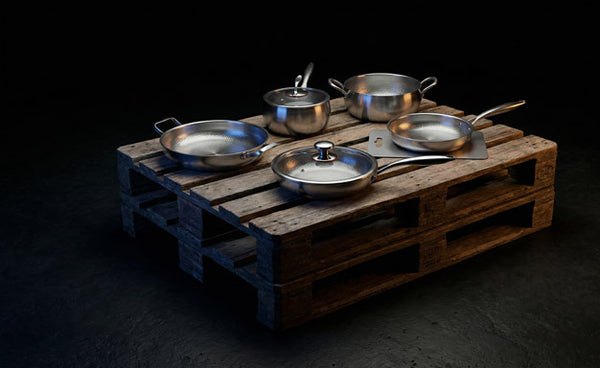
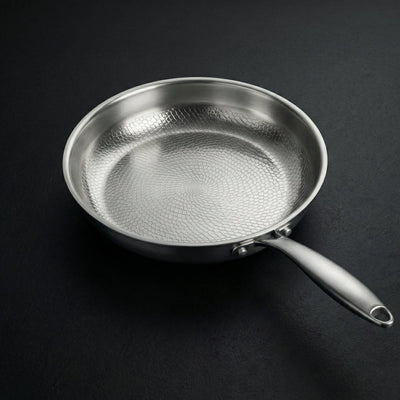
At Okura, we bring together a distinctive hammered finish, a distinctive cooking surface and a practical layered construction.
The result is cookware that feels considered, from the way it looks in your kitchen to the way it fits into your daily routine.
Good ingredients.
A considered surface.
A meal worth sitting down for.

02 / Know what you cook on
“PFOA-free” is only
part of the story.
PFOA is one substance within the wider PFAS family. A PFOA-free label alone does not tell you whether a pan is free from every PFAS.
Some conventional non-stick pans use PTFE, a fluoropolymer within the broad PFAS definition. Others use different materials. Look beyond the label and ask what the actual cooking surface is made from.
“Is the surface a synthetic coating, or is it the metal itself?”
From the cooking surface to your food
Can a pan contribute
to PFAS exposure?
It depends on the material and how it is used. PTFE is a PFAS fluoropolymer used in some non-stick coatings.
Very small transfers.
Fluorinated substances remaining from manufacturing can transfer from PTFE coatings to food. BfR considers the amounts too small to expect adverse health effects when cookware is used correctly.
Overheating matters.
At around 360°C and above, PTFE can decompose and release hazardous gases that can be inhaled. Avoid heating an empty coated pan and follow its heat limits.
Flakes are different.
Accidentally swallowed PTFE coating particles are not digested and are excreted unchanged, according to BfR. They should not be described as particles that stay in your body forever.
What can stay in the body?
Certain absorbed PFAS, such as PFOA and PFOS, are eliminated slowly and can build up with repeated exposure. How long they remain depends on the substance. This is different from swallowing a PTFE flake, and does not establish that your pan caused your body's PFAS level.
Food and drinking water are important exposure sources. Changing cookware does not remove PFAS already in your body.
Sources: BfR cookware assessment, July 2025 ↗ · ATSDR
03 / The Okura difference
A considered design.
Check every layer.
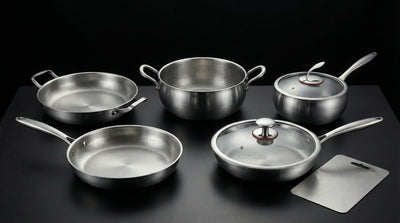
Okura describes its cookware as a layered design. Match the specifications to your exact model, and read the laboratory test scope below.
Marketed as a titanium cooking surface without a PFAS-based coating. The supplied report does not independently verify these material claims.
Titanium alone is not a strong heat conductor. The enclosed aluminum core helps spread heat across the pan.
Built for induction, gas, electric and ceramic stovetops.

04 / Made for everyday life
A considered choice.
A genuinely useful pan.
Breakfast before school. A proper sear at dinner. Less fuss when it is time to clean up.

Cook with confidence
A durable metal surface made for everyday meals and metal utensils. Preheat gently, add oil or butter, and let your food release naturally.

Fits your kitchen
From induction to gas, electric and ceramic. Oven-safe cookware gives you more ways to finish a dish.

Dinner done. Cleanup easy.
Dishwasher-safe for busy evenings. Let your pan cool before washing, and use a soak when food needs a little encouragement.
For everything you bring to the table
More than what you cook.
Who you cook for.
The quick weeknight dinner. The Sunday lunch that runs late. The meal you make when everyone finally gets home.
Choose a pan that belongs in all of those moments: versatile, easy to care for and made without a synthetic non-stick coating.
Make room for Okura ↗
A closer look at materials
Know the difference
before you choose.
| At a glance | PTFE-coatedConventional non-stick | OKURACookware |
|---|---|---|
| Cooking surface |
Synthetic coatingPTFE non-stick surface
|
Titanium specificationSee material verification below.
|
| Without a PFAS-based coating |
NoPTFE belongs to the PFAS family.
|
Specified without PFASNot verified by the supplied lab report.
|
| Metal utensils |
Usually discouragedFollow the manufacturer’s guidance.
|
SuitableMade for everyday metal utensils.
|
| Cooking technique |
Easy releaseUse within the recommended heat limits.
|
Sear & releasePreheat, add fat and allow food to release.
|
| Warranty |
Varies by brandCheck the specific product terms.
|
25 yearsSubject to Okura warranty terms.
|
✓ Included / suitable× Not included / usually discouragedi Check specifications
This compares materials, not every pan on the market. PFAS-free ceramic and uncoated metal alternatives also exist.
OKURA / Product documentation
Tested cookware.
Documented results.
Our supplied Eurofins report records food-contact test results for the submitted Hand-Hammered Titanium Pan sample.
This is an Okura summary of the original report, not a separate laboratory certificate.
Issued 07 July 2026
Applicant: Okura Cookware
Sample: Hand-Hammered Titanium Pan
Metal migration
The listed specific-release tests returned results below their method detection limits under the reported test conditions.
0.5% citric acid · 2 hours at 100°C · report p. 6Odour & taste
Odour: 0.0. Taste: 0.0. Both were below the report's acceptance limit of 2.5.
DIN 10955:2024 · report p. 5Pan material test
The tested metal component met the report’s chromium-content requirement: 16.20%, against a minimum of 16%.
Component 1 · total chromium · report p. 10Pan component / Migration results
24 elements tested.
All below detection limits.
PASSEDReported test conditions
The report tested release from component 1, identified as the metal pan body, lid frame and eyelet. Each element below was reported as not detected in both the combined first and second migrations and the third migration.
- Aluminum (Al)Migration: not detected
- Antimony (Sb)Migration: not detected
- Chromium (Cr)Migration: not detected
- Cobalt (Co)Migration: not detected
- Copper (Cu)Migration: not detected
- Iron (Fe)Migration: not detected
- Manganese (Mn)Migration: not detected
- Molybdenum (Mo)Migration: not detected
- Nickel (Ni)Migration: not detected
- Silver (Ag)Migration: not detected
- Tin (Sn)Migration: not detected
- Vanadium (V)Migration: not detected
- Zinc (Zn)Migration: not detected
- Zirconium (Zr)Migration: not detected
- Arsenic (As)Migration: not detected
- Barium (Ba)Migration: not detected
- Beryllium (Be)Migration: not detected
- Cadmium (Cd)Migration: not detected
- Lead (Pb)Migration: not detected
- Lithium (Li)Migration: not detected
- Mercury (Hg)Migration: not detected
- Thallium (Tl)Migration: not detected
- Magnesium (Mg)Migration: not detected
- Titanium (Ti)Migration: not detected
ICP-MS · 0.5% citric acid · 2 hours at 100°C · report pp. 6–7. “Not detected” means below the method detection limit for that element. These are release results, not a list of substances absent from the pan. Magnesium and titanium have no specific release limit listed in the report.
Complete pass summary
Every test marked “Pass” in the report.
-
✓Odour & tasteSubmitted sample · page 5PASS
-
✓Specific release of heavy metalsMetal component 1 · pages 6–7PASS
-
✓Total chromium contentMetal component 1 · page 10PASS
-
✓Leachable lead & cadmiumGlass lid · page 8PASS
-
✓Leachable cobaltGlass lid · page 9PASS
-
✓Interior lead & cadmium releaseGlass lid · page 11PASS
What this report does — and does not — establish
The results apply to the tested sample and stated conditions. “Not detected” means below a method's detection limit; it does not mean absolute zero or that the material contains no metals.
This report contains no PFAS analytical test and is not a PFAS-free certificate. It also does not verify a pure titanium cooking surface: the titanium content test lists component 1 as not detected (detection limit 50 mg/kg) and component 3 at 91 mg/kg (report p. 12). Product material descriptions should not be treated as conclusions of this report.
Important · Beware of copycats
They can copy the look.
Don’t assume they can prove the claims.
Lookalike pans can use similar photos and titanium claims without providing a verifiable lab certificate for the product being sold.
No verifiable lab certificate? Do not take the material claims at face value. A similar appearance does not establish the same construction, test results or quality.
Original Okura cookware is only available through our official website.
okuracookware.com ↗Before you buy, check these three things
-
01The website addressFor original Okura, check that you are shopping on okuracookware.com.
-
02A verifiable lab reportLook for the issuing laboratory, report date, product identification and what was actually tested.
-
03The actual cooking surfaceCheck whether the titanium is the cooking surface, an ingredient in a coating, or simply part of the product name.
A logo, badge or product photo is not a substitute for a product-specific report.
Built for the meals ahead
The pan you reach for today.
And for years to come.
A lasting kitchen upgrade should come with lasting support. Okura cookware comes with a 25-year warranty, subject to the applicable product warranty terms.
Find your everyday panThe everyday Okura ritual
A little technique.
A lot to look forward to.
Real titanium cooks differently from coated non-stick. A few simple habits help you get comfortable with your new pan.

Warm it gently.
Start with moderate heat and allow the pan to preheat. You do not need the highest setting for every meal.
Add a little fat.
Add oil or butter before your food. Match the heat to the ingredient and leave room in the pan.
Give it a moment.
Let protein form a crust before turning. After dinner, allow the pan to cool before cleaning.
OKURA COOKWARE · Made for your everyday cooking
Good questions. Clear answers.
Before you make the switch.
Will switching pans reduce PFAS in breast milk?
There is no evidence presented here that switching to Okura lowers PFAS in breast milk or prevents health problems. PFAS exposure comes from multiple sources. Choosing a pan without a PFAS-based coating is a materials preference, not a medical treatment.
Should I stop breastfeeding because of PFAS?
No. RIVM and the Dutch Nutrition Centre advise continuing breastfeeding where possible. If you have personal concerns, speak with your healthcare professional.
Is Okura solid titanium all the way through?
Okura describes a layered construction rather than solid titanium throughout. The supplied laboratory report does not confirm a pure titanium cooking surface. Check the specifications and product-specific documentation for the exact model.
Does food slide around without any oil?
Uncoated titanium cooks differently from PTFE-coated non-stick cookware. Use appropriate heat, allow the pan to preheat and add a little oil or butter. Give protein time to form a crust before turning it.
Does it work on induction, and can it go in the dishwasher?
Yes. Okura cookware works on induction, gas, electric and ceramic stovetops and is dishwasher-safe. Follow the care guidance and the oven limits for your specific pan and lid.
Where can I buy the original Okura cookware?
Original Okura cookware is only available at okuracookware.com. Be cautious with lookalikes on other websites and ask for a verifiable, product-specific lab report instead of relying on photos or badges.

Your next kitchen essential
You choose the ingredients.
Choose the surface, too.
Discover Japanese-inspired titanium cookware made for the way you actually cook. Explore the pans, sizes and sets in the current collection.
Shop the Okura collection