



Comparisons
Ceramic vs Granite Cookware
The ceramic vs granite cookware comparison hides a detail most shoppers miss: neither is a solid material you cook on. Both are non-stick coatings applied to a metal pan. “Ceramic” describes a sol-gel coating; “granite” describes a speckled finish designed to look like stone. Once you know that, the comparison gets a lot clearer.
What “granite” cookware actually is
Granite cookware is not made of granite. It is typically an aluminium or cast-aluminium pan finished with a speckled, stone-look non-stick coating. That coating can be ceramic-based or a reinforced PTFE-type layer, depending on the maker — which is why “granite” tells you about the appearance, not the chemistry. If PFAS or PTFE matters to you, the speckled look alone will not tell you; you have to read what the coating is actually made of.
Its strengths: granite-style coatings often feel more robust and scratch-resistant than plain ceramic, they look attractive, and better versions are marketed as PFOA-free. They release food well when new.
What ceramic cookware is
Ceramic cookware uses a sol-gel (silica-based) non-stick coating over aluminium or steel. It is genuinely slick when new, releases with little fat, and reputable versions are free of PFAS and PTFE — which is much of its appeal. It is usually affordable and comes in a wide range of colours.
The weakness is shared with granite and with all coatings: it wears. Ceramic tends to lose its easy release within one to three years, faster on high heat or with metal utensils. When the coating fades, the pan's usefulness fades with it.
Ceramic and “granite” are both coatings with a shelf life. The name describes the look and the recipe of the film on top — not a stone surface you are cooking on.
Ceramic vs granite, side by side
- What it is: both are coatings over metal, not solid materials.
- PFAS/PTFE: quality ceramic is typically free of both; “granite” varies — check the specific coating.
- Durability of the coating: granite-style is often marketed as tougher, but both eventually wear.
- Metal utensils: best avoided on both.
- Lifespan: measured in a few years for both, not decades.
Which should you buy?
Between the two, choose based on the coating you can verify: a reputable PFAS-free ceramic pan is a sound pick if you want the cleanest coating recipe and do not mind replacing it in a couple of years, while a granite-style pan may feel a little more rugged — provided you confirm what its speckled layer actually is. Either way, treat both gently: low-to-medium heat, no metal utensils, soft sponges. That care is what a coated pan asks in exchange for its easy release.
If you would rather skip coatings entirely
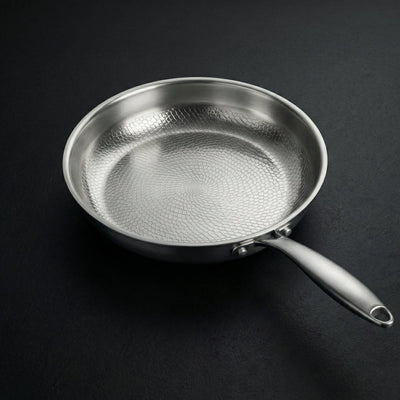
Both of these are coated pans, and every coating is on a replacement clock. If you would prefer a surface that never wears out, solid titanium is the alternative: the cooking surface is the metal itself — inert, non-toxic, free of PFAS, PTFE, lead and cadmium — with nothing to flake, fade or leach. It is safe with metal utensils, handles high heat, and releases food naturally once pre-heated. Explore it in our Japanese pans collection.
The Cookware
Built to Last
Uncoated grade-1 titanium. No PFAS, no coatings, backed by a 25-year warranty.
Shop the Collection