



Japanese Knives
Damascus Knife Sets, Explained
A Damascus knife set is one of those purchases that looks stunning and raises a lot of questions — starting with whether the rippling pattern is real craftsmanship or just decoration. Here is a plain explanation of what Damascus steel is, what a good set should include, how it performs, and who it is actually for, so you can judge a set on substance instead of the photo.
What Damascus steel actually is
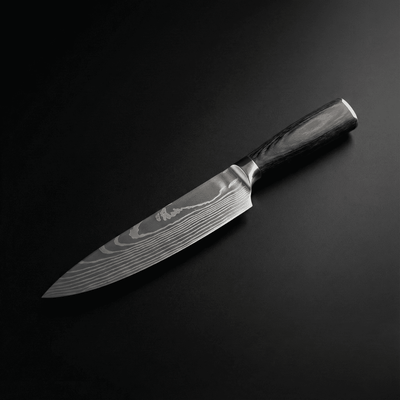
Modern Damascus steel is pattern-welded: two or more types of steel are forge-welded together in layers, folded, and worked until the finished blade contains dozens of alternating bands. When the surface is etched, those bands show up as the flowing, water-like pattern Damascus is known for. The pattern is not printed on — in a genuine Damascus blade it runs through the steel, a record of how the layers were folded.
One point worth understanding: on most quality kitchen knives, the Damascus layers are the cladding around a harder core of cutting steel. The core is what holds the edge; the layered outer steel protects it, adds toughness, and creates the pattern. So the beauty and the performance come from two different parts of the same blade working together.
On a good Damascus knife, the pattern is a by-product of how it is built — not the reason it cuts well. The core steel does that.
What a good set includes
You do not need a block of fifteen knives. Most cooks are covered by a small number of well-chosen blades, and a sensible Damascus set is built around them:
- A chef's knife: the workhorse for most cutting, chopping, and slicing.
- A santoku: for lighter, precise downward cuts on vegetables and boneless proteins.
- A utility or paring knife: for small, detailed work a large blade cannot do neatly.
Beyond that, extra knives are about preference, not necessity. A set is worth more for the quality of each blade than for the number of pieces in the box.
Edge retention and performance
The thing that makes a Damascus knife cut well over time is the hardness of its core steel, not the layer count. A harder core holds a sharp edge longer between sharpenings, which is the practical benefit you feel day to day. The layer count you see quoted is mostly about appearance — more folds, a more intricate pattern — and beyond a point it tells you little about how the knife performs. Judge a set on its core steel and how it is finished, and treat the pattern as the bonus it is.
Care: harder steel asks for a little respect
Harder, higher-performance steel takes a keen edge but is less forgiving than a soft Western blade, so the care matters.
- Hand wash and dry immediately — never the dishwasher, where heat, detergent, and knocks all do damage.
- Cut on wood or a soft board, not glass or stone, which chip a hard edge.
- Hone to keep the edge true, and sharpen on a whetstone when it finally needs it.
- Store it on a magnetic strip or in a guard so the edge is not knocking around a drawer.
Damascus vs a plain single-steel knife
A well-made single-steel knife can cut every bit as well as a Damascus one — the layered construction is not what makes an edge sharp. What Damascus adds is a combination: a hard, edge-holding core wrapped in tougher, more forgiving outer steel, finished with a pattern that happens to be beautiful. You are paying for the craft of forge-welding and finishing as much as for raw cutting ability. That is a fair trade if you value how a knife looks and feels in the hand, and a poor one if you only care about the edge, where a simpler knife costs less and performs similarly.
The reasonable way to think about it: buy Damascus because you want blades you will enjoy using and keeping for years, not because you expect the pattern to cut for you. On that basis, a small, well-made set beats a large, cheap one every time.
Who a Damascus set is for
A Damascus set suits the cook who uses their knives often and wants blades that hold an edge, feel precise, and happen to look the part on the counter. If you rarely cook, or you want something you can throw in the dishwasher and forget, it is more knife than you need. If you prep most days and will take ten seconds to dry a blade, it earns its place.
To compare blades and build a set around the pieces you will actually use, browse our chef's knives.
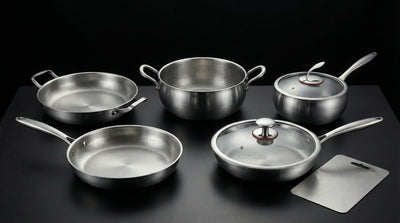
The Cookware
Built to Last
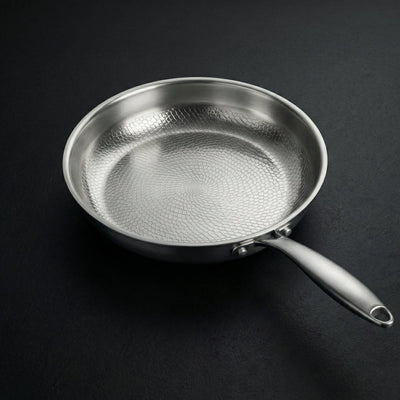
Uncoated grade-1 titanium. No PFAS, no coatings, backed by a 25-year warranty.
Shop the Collection