



Non-Toxic
Does Hard-Anodized Cookware Have PFAS?
If you are shopping for safer cookware, "hard-anodized" gets thrown around like a guarantee. So it is worth asking plainly: does hard-anodized cookware have PFAS? The honest answer is that the hard-anodized surface itself does not — but the pan sitting in the store almost always has something else on top of it.
What "hard-anodized" actually means
Hard-anodizing is a process, not a coating. Manufacturers take an aluminium pan and run it through an electrochemical bath that thickens and hardens the aluminium's own oxide layer. The result is a darker, denser, more scratch-resistant surface that is genuinely tougher than raw aluminium. Crucially, that anodized layer is just oxidised aluminium — there is no PFAS, no PTFE and no fluoropolymer chemistry involved in the anodizing step itself.
So if a pan were sold as bare hard-anodized aluminium and nothing else, the PFAS question would be simple. The problem is that this is almost never what you are buying.
Where the PFAS usually hides
Most cookware labelled "hard-anodized" is really "hard-anodized non-stick." The anodized aluminium is the body; a separate non-stick coating is sprayed over it to make food release. That coating is where PFAS can live. Traditional non-stick films are built on PTFE — itself a member of the PFAS family — and older or cheaper coatings may involve other fluorinated compounds in manufacturing. The marketing highlights the durable metal underneath and stays quiet about the thin chemical layer you actually cook on.
Hard-anodized describes the metal underneath. PFAS, when it is present, lives in the non-stick coating on top of it.
How to read the label
A few phrases tell you what you are really getting:
- "PFOA-free" is not the same as PFAS-free. PFOA is one retired chemical; the coating can still be PTFE-based and still be a PFAS.
- "Hard-anodized non-stick" means there is a release coating over the metal — ask what it is made of.
- "Ceramic hard-anodized" usually points to a sol-gel coating rather than PTFE, but it is still a coating with a finite lifespan.
- Silence about the cooking surface usually means a conventional fluoropolymer coating.
Why coatings are the weak point
Even a well-made non-stick coating over hard-anodized aluminium is temporary. Metal utensils, high heat and time all wear it down, and once it starts to flake the aluminium body is exposed and the pan is usually replaced. The anodized layer buys durability for the metal, but it does nothing to make the coating on top permanent.
Is the aluminium underneath a concern?
Hard-anodizing exists partly to address this: sealing the aluminium behind a hardened oxide layer makes the metal far less reactive than bare aluminium. As long as that anodized surface and any coating stay intact, the aluminium is not the headline issue — the coating is. The trouble is that both the coating and, eventually, the sealed surface wear with use, which brings you back to the same place: a pan whose safety depends on a layer that is designed to break down.
The solid-material alternative
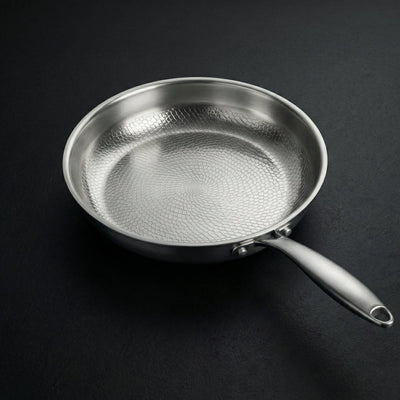
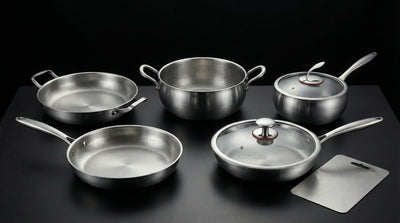
The way to sidestep the question entirely is to cook on a material that never needed a coating in the first place. Solid titanium is one pan of one thing: there is no film between your food and the metal, so there is no PFAS, PTFE, lead or cadmium in the cooking surface and nothing to leach or flake away. Titanium is naturally inert and biocompatible — the same reason it is trusted for medical implants — takes metal utensils, moves from induction to oven, and at roughly 45% lighter than steel is easy to handle. You can see the approach across our Japanese pans collection, all built from uncoated titanium and backed by a 25-year warranty.
If you already own hard-anodized non-stick
You do not need to panic-replace a pan that is in good condition. The practical guidance is simple: avoid high, empty-pan heat, skip metal utensils that scratch the coating, and retire the pan once the surface is visibly worn or flaking rather than cooking on a damaged film. When it is time to replace it, that is the moment to decide whether you want another coating on the clock — or none at all.
The bottom line
Does hard-anodized cookware have PFAS? The anodized aluminium does not — but the non-stick coating layered over it very often does, and that coating is the surface you actually cook on. If avoiding PFAS is the goal, the reliable answer is not a tougher coating but no coating at all.
The Cookware
Built to Last
Uncoated grade-1 titanium. No PFAS, no coatings, backed by a 25-year warranty.
Shop the Collection