



Non-Toxic
Is Granite Cookware Non-Toxic?
"Granite" cookware looks reassuringly natural — those speckled, stone-like pans suggest something solid and safe. So it is fair to ask: is granite cookware non-toxic? The honest answer starts with a surprise — there is usually no granite in it at all. What you are really buying is a coating, and that is where the real question lives.
What "granite" cookware actually is
Granite cookware is not carved from stone. In almost every case it is an aluminium (sometimes steel) pan finished with a speckled coating designed to look like granite. The name describes the appearance, not the material. That matters, because whether the pan is non-toxic depends entirely on what that coating is made of and how well it holds up — not on any mineral it is named after.
"Granite" is a look, not a material. The safety question is really a question about the coating underneath the speckles.
The coating is the whole question
Granite-style coatings vary widely. Some are reinforced non-stick films built on PTFE — a member of the PFAS family — dressed up with a stone-effect finish. Others are sol-gel "ceramic" style coatings marketed as PFAS-free. Because the label often just says "granite" or "stone," you frequently cannot tell which one you are getting without asking. A pan is only as non-toxic as the film you cook on, and that film is exactly what the marketing tends to leave vague.
What happens as it wears
Every coating has a finite life. Granite-style finishes are often promoted as tougher than plain non-stick, but they still chip, scratch and wear with metal utensils, high heat and time. Once the coating is breached, the aluminium body underneath is exposed and the pan is usually on its way out. "More durable" is not the same as permanent, and a chipped coating is no longer the surface you thought you bought.
How to judge a granite pan
- Find out what the coating is. "PFOA-free" does not mean PFAS-free; a PTFE-based film is still a PFAS.
- Treat "stone" and "granite" as marketing. Ask what the surface is actually made of.
- Check the substrate. Most are aluminium, which you do not want exposed once the coating fails.
- Assume it is replaceable. Any coated pan is a consumable, however tough the finish sounds.
The solid-material alternative
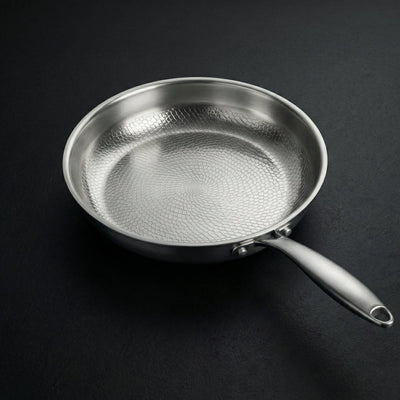
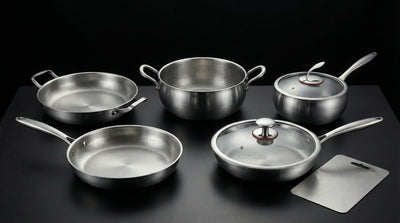
The way to stop worrying about a coating is to cook on a material that never needed one. Solid titanium is a single, uncoated material: there is no film between food and metal, so there is no PFAS, PTFE, lead or cadmium in the cooking surface, nothing to leach and nothing to flake off as it ages. Titanium is naturally inert and biocompatible — the reason it is trusted for medical implants — takes metal utensils without worry, and moves from induction to oven freely. You can see the approach across our Japanese pans collection, built from uncoated titanium and backed by a 25-year warranty.
The bottom line
Is granite cookware non-toxic? It depends entirely on a coating the name conveniently hides — and that coating will not last forever. If avoiding that uncertainty matters to you, a solid, uncoated material answers the question once instead of pan after pan.
The Cookware
Built to Last
Uncoated grade-1 titanium. No PFAS, no coatings, backed by a 25-year warranty.
Shop the Collection