




Titanium Safety
Is Titanium Cookware Safe? What the Science Actually Says
Titanium has quietly become one of the most talked-about materials in the kitchen — and one of the most misunderstood. If you are weighing a titanium pan against the non-stick already sitting in your cupboard, the real question is simple: is it actually safe to cook on, every day, for years? Here is what the science supports, in plain terms.
The short answer
Yes. Solid titanium is one of the most biocompatible materials we know of — inert enough that surgeons use it for implants meant to stay inside the human body for decades. In a pan it behaves the same way: stable, non-reactive, and free of the coatings that turn conventional non-stick into a question mark. The reassurance isn't marketing; it comes from the metal's basic chemistry.
Why titanium is inert
Titanium owes its stability to that chemistry. The instant its surface meets air, it forms an ultra-thin, remarkably stable oxide layer that seals the metal beneath. That passive layer is what stops titanium from reacting with acids, salts and the everyday chemistry of cooking — tomato sauce, a squeeze of citrus, a long wine reduction. It is the same property that makes titanium the material of choice for medical implants and aerospace components: it holds its structure and does not break down under the kind of stress a stovetop could ever apply.
Titanium is trusted inside the human body for decades. A frying pan is a far gentler environment.
No coatings, nothing to leach
This is the part that matters most for daily cooking. A solid titanium pan is exactly that — solid metal, with no sprayed-on film sitting between your food and the surface. There is no PFAS, no PTFE, no PFOA, no lead and no cadmium in the cooking surface. Because those substances were never part of the pan, there is nothing for them to leach into your food, and nothing to flake off into a pan of scrambled eggs.
Contrast that with how most conventional pans are built — a metal body with a chemical non-stick layer applied on top. The pan is only ever as safe as that coating, and coatings are designed to be temporary. Once they begin to break down, the surface you're cooking on is no longer the surface you bought.
What about heat tint / discoloration?
Cook on titanium for a while and you may see a faint rainbow or bronze tint bloom across the surface. This is expected, and it is not a defect. Heat tint is simply that oxide layer growing slightly thicker and bending light differently — the same effect you notice on a well-used titanium bike frame or a surgeon's instrument tray. It is purely cosmetic. It does not mean a coating is failing, because there is no coating to fail; it does not mean the metal is degrading. If the look bothers you, a little polish brings the shine back. If it doesn't, take it as a sign the pan is doing exactly what it should.
Titanium vs coated "non-stick" pans
The everyday difference comes down to permanence. A coated pan releases food beautifully — right up until the coating wears, at which point performance drops and most people replace the whole pan. Solid titanium takes a different path: its release comes from technique and a properly pre-heated surface rather than a film, so there is no coating with an expiry date. You can use metal utensils on it. You can move it from induction to oven to open flame. And you are not locked into a two-to-three-year replacement cycle.
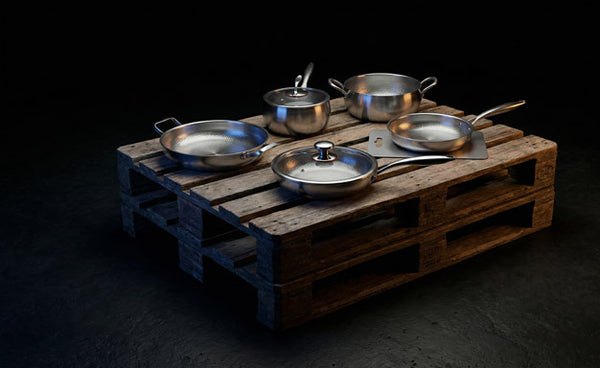
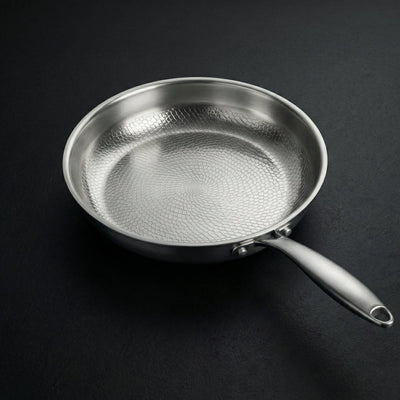
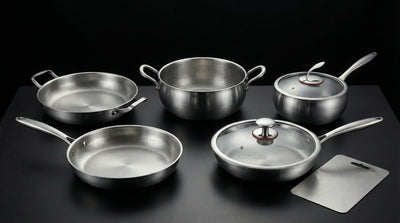
Explore the full range in our Japanese pans collection, or start where most people do — with the hand-hammered titanium pan.
The bottom line
If your concern is what ends up in your food, solid titanium is about as reassuring as cookware gets: biocompatible, chemically stable at normal cooking temperatures, and free of the coatings and heavy metals people rightly worry about. It is the same reasoning that has titanium trusted for surgical implants, applied to the pan on your stove. That confidence is exactly why every Okura pan is backed by a 25-year warranty.
The Cookware
Built to Last
Uncoated grade-1 titanium. No PFAS, no coatings, backed by a 25-year warranty.
Shop the Collection