



Non-Toxic
Non-Toxic Griddle Pan: What to Look For
A griddle pan earns its keep searing steaks, pancakes and weekend breakfasts — which is exactly why you want a non-toxic griddle pan you can heat hard without second thoughts. The catch is that "non-toxic" gets stamped on a lot of pans that do not deserve it. Here is what actually matters and what to look for.
Why the griddle format raises the stakes
Griddles live at high heat. You use them to sear, char and brown, often hotter and for longer than a regular frying pan. That is precisely the condition under which cheap non-stick coatings struggle — high heat is what degrades them fastest. So a coating that seems fine on a low simmer can be the weak point on a screaming-hot griddle, which makes the surface material the first thing to get right.
What "non-toxic" should actually mean
Ignore the badge and look for substance. A genuinely non-toxic griddle should be:
- Free of PFAS and PTFE in the cooking surface, so nothing fluorinated can break down at high heat.
- Free of lead and cadmium — no heavy metals in anything that touches food.
- Non-leaching, meaning the material stays put instead of migrating into your food.
- Able to take real heat without a coating that degrades when you push the temperature.
- Metal-utensil safe, because a griddle sees a lot of spatula work.
On a griddle you cook hot. The safest surface is one with nothing on it to break down when the heat climbs.
The material options, honestly
A few materials clear the bar in different ways. Cast iron and carbon steel are solid, coating-free and take high heat well, though they need seasoning and careful drying to fend off rust. Stainless steel is inert and durable but not naturally non-stick. Coated "non-stick" griddles release food easily but reintroduce the very coating question you were trying to avoid — and high griddle heat is hard on that coating.
Why solid titanium fits the griddle job
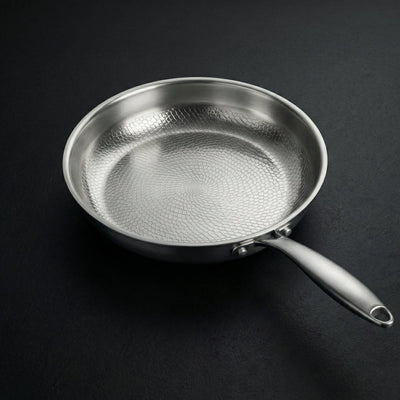
Solid titanium answers most of the list at once. It is one uncoated material, so there is no PFAS, PTFE, lead or cadmium in the cooking surface and nothing to leach or flake — even when you run it hot. It is naturally inert and biocompatible, the same property that has titanium trusted for medical implants. It is metal-utensil safe, moves from induction to oven to flame, and at roughly 45% lighter than steel it is far easier to lift and manoeuvre than a heavy cast-iron slab. Release comes from a properly pre-heated surface and technique rather than a coating with an expiry date.
How to shop for one
Read past the word "non-toxic" to what the surface actually is. Ask whether there is a coating and what it is made of; treat "PFOA-free" as no guarantee against PFAS; and favour a solid material you can heat hard and scrub without babying a film. A griddle you can sear on confidently for years beats one you replace when the coating gives out.
Our hand-hammered titanium pan is built on exactly this logic, and you can see the full range in our Japanese pans collection — all uncoated titanium, backed by a 25-year warranty.
The bottom line
A non-toxic griddle pan is really about the cooking surface: no PFAS, no heavy metals, nothing that breaks down under the high heat a griddle demands. Choose a solid, uncoated material and you get to cook hot and worry less.
The Cookware
Built to Last
Uncoated grade-1 titanium. No PFAS, no coatings, backed by a 25-year warranty.
Shop the Collection