



Titanium Safety
Titanium Cookware Health Risks: What the Science Actually Says
Type "titanium cookware health risks" into a search bar and the results range from calm to alarmed. It is a fair thing to check — you cook on a pan almost every day, for years. So here is the honest, unhyped answer: the health risk from solid titanium cookware is very low, and most of the fears attached to it actually belong to a different kind of pan entirely. Here is what the science supports and what it does not.
The honest answer first
Solid titanium is one of the most biocompatible materials we know of. It is inert enough that surgeons implant it in the human body and leave it there for decades. In a pan, it behaves the same way: stable, non-reactive, and free of the coatings that make people nervous about cookware in the first place. If your worry is what ends up in your food, solid titanium is one of the more reassuring materials you can cook on. The reassurance is not a slogan — it comes from the metal's chemistry.
What people worry about vs what is real
Most concerns about "titanium cookware" fall into a few buckets. It helps to separate them.
- Leaching: the fear that metal migrates into food. Titanium forms an ultra-thin, stable oxide layer the instant it meets air, and that passive layer is what stops it reacting with acids, salt, or a long tomato reduction. There is nothing sprayed on to leach, and the metal itself is not reactive.
- Heavy metals: the worry about lead or cadmium. Solid titanium cookware does not contain them. They were never part of the pan, so there is nothing to release.
- "Titanium" that is really a coating: this is where confusion creeps in. Many pans sold as "titanium" or "titanium-infused" are ordinary non-stick pans with a titanium-coloured or titanium-reinforced coating on top. Those are coated pans, and they carry a coated pan's risks — not the properties of solid titanium. It is the single most important distinction on this whole topic.
Most "titanium cookware" fears are really coating fears. Solid titanium has no coating for them to apply to.
Coatings are the real risk in other pans
The health questions people attach to cookware — flaking, fumes at high heat, substances you would rather not eat — trace back to non-stick coatings, not to base metals. A conventional non-stick pan is a metal body with a chemical film on top, and that film is designed to be temporary. As it wears it can flake, and overheated it can degrade. Solid titanium sidesteps the entire category: there is no PFAS, no PTFE, no PFOA, and no film between your food and the surface, because the pan is one material all the way through.
Heat tint is cosmetic, not a warning
Cook on titanium for a while and you may notice a faint rainbow or bronze bloom on the surface. It looks like something happening, but it is not a health signal. Heat tint is just that oxide layer growing slightly thicker and bending light differently — the same effect you see on a well-used titanium bike frame or a surgical tray. It does not mean a coating is failing, because there is none to fail, and it does not mean the metal is breaking down. A little polish removes it if you want; leaving it changes nothing about how safe the pan is.
What about high heat?
High heat is exactly where coated pans get into trouble and solid metal does not. Titanium has a very high melting point and no surface film to break down, so searing, stir-frying, or moving the pan from induction to a hot oven does not create the fumes associated with overheated non-stick. The sensible limits at high heat are about your food and your oil, not the metal underneath them.
When should you actually replace it?
This is where solid titanium differs most from a coated pan. A non-stick pan has a built-in clock: once the coating wears, most people replace the whole thing, often within a few years. Solid titanium has no coating with an expiry date. You replace it if it is physically damaged — badly warped or cracked — not because a surface layer has worn out. For most cooks, that means a pan that stays in service far longer, which is also why Okura backs every pan with a 25-year warranty.
The bottom line
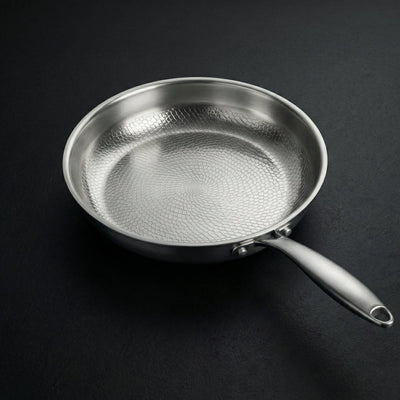
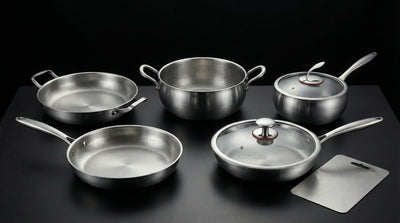
On the evidence, solid titanium cookware is a low-risk choice: inert, stable at normal cooking temperatures, free of coatings and heavy metals, and trusted enough for use inside the human body. The risks people read about are overwhelmingly about coatings — which solid titanium does not have. If you want to cook on the material itself, browse our Japanese pans, or start with the hand-hammered titanium pan.
The Cookware
Built to Last
Uncoated grade-1 titanium. No PFAS, no coatings, backed by a 25-year warranty.
Shop the Collection