



Comparisons
Titanium Cookware vs Stainless Steel
Put titanium cookware vs stainless steel side by side and you are comparing two coating-free, long-lasting metals that go about cooking very differently. Stainless is the established all-rounder found in most professional kitchens. Titanium is the lighter, fully inert alternative. Here is how they actually stack up — strengths and weaknesses on both sides.
Stainless steel: the proven all-rounder
Stainless steel earns its reputation. It is non-reactive with acids and salt, tough enough to take metal utensils and the dishwasher, and — in a fully clad or tri-ply build — it heats evenly and responds fast thanks to an aluminium or copper core. It browns beautifully and builds fond for sauces.
Its honest limits: bare stainless is not non-stick, so it demands a proper preheat and enough fat or food sticks. Lower-end single-ply pans can develop hot spots. And stainless is comparatively heavy in the hand.
Titanium: light, inert, coating-free
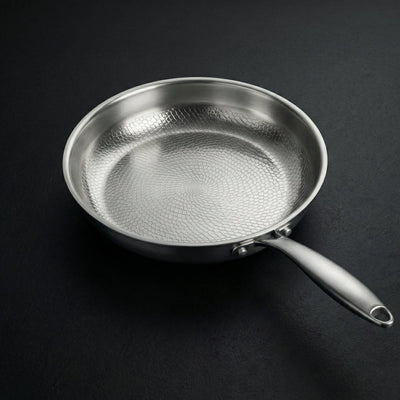
Solid titanium's headline advantages are weight and inertness. It is around 45% lighter than a comparable stainless pan, which changes how a skillet feels through a long session at the stove. It is biocompatible and non-toxic — the metal surgeons trust for implants — with no PFAS, PTFE, lead or cadmium, and nothing coated on to wear away. Well pre-heated, it releases food naturally, it is safe with metal utensils, and it moves from induction to oven to open flame without complaint.
The honest trade-offs matter too. Titanium has lower thermal conductivity than a copper- or aluminium-cored stainless pan, so it heats less evenly on its own and rewards a proper preheat and a moment to let the surface settle. Its natural release comes from technique, not a slick film, so there is a short learning curve. And it sits at a premium price.
Stainless steel spreads heat more evenly out of the box; titanium is lighter, fully inert, and free of any coating that can wear out. Each asks something different of the cook.
Side by side
- Weight: titanium wins — roughly 45% lighter.
- Even heating: clad stainless wins, thanks to its conductive core.
- Reactivity: a tie — both are non-reactive with acidic food.
- Non-stick: titanium releases naturally with a preheat; bare stainless does not.
- Maintenance: a tie — no seasoning, no coating to baby on either.
- Longevity: both last for decades; Okura titanium carries a 25-year warranty.
Living with each pan
Day to day, the difference shows up in small ways. Stainless steel is forgiving of neglect — leave it, scrub it, run it through the dishwasher — but it will remind you to preheat every time you crack an egg. Titanium asks for that same preheat, then largely gets out of the way: lighter to lift, quick to clean, and never at risk of a coating flaking into dinner. Neither needs seasoning, and neither rusts. Over a decade of cooking the gap in upfront price narrows, because you are not replacing either one on the non-stick pan's usual schedule.
Which is right for you?
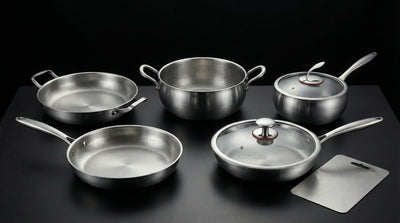
Choose clad stainless steel if even, hands-off heat distribution and the lowest price of entry are your priorities. Choose titanium if you want the lightest pan, a fully inert coating-free surface, and natural release you never have to replace. Many cooks find titanium becomes the pan they reach for daily, with stainless kept for tasks that reward its even heat. See the range in our Japanese pans collection.
The Cookware
Built to Last
Uncoated grade-1 titanium. No PFAS, no coatings, backed by a 25-year warranty.
Shop the Collection