



Japanese Knives
What Is a Santoku Knife Used For?
If you have ever reached for a Japanese knife and wondered what a santoku knife is used for, here is the short version: it is an all-purpose kitchen knife built for precise, controlled cuts of vegetables, herbs, and boneless proteins. It is the knife most home cooks in Japan pick up first, and once you understand how the blade is shaped, the reasons become obvious.
What a santoku knife is
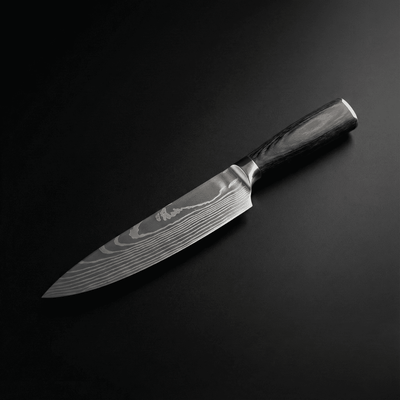
Santoku means "three virtues," a reference to the three jobs it does well: slicing, dicing, and mincing. It is shorter than a Western chef's knife — usually 5 to 7 inches — with a flatter cutting edge and a rounded, sheep's-foot tip that curves down to meet the blade. The result is a knife that feels light in the hand and stays close to the board, which is exactly what you want for fast, repetitive prep. It is a generalist: not specialised for one job, but reliable across most of them, which is why it tends to become the knife you reach for without thinking.
The flat blade and the granton edge
Two features define how a santoku cuts. The first is the flat profile. Where a chef's knife has a curved belly built for rocking, a santoku has a straighter edge that sits almost flush against the board. That suits a push cut — you lift the whole blade, place it over the food, and press straight down. It is a cleaner, more deliberate motion, and it gives you even slices without the blade skating forward.
The second is the granton edge: the row of shallow scallops, or dimples, ground into the sides of the blade. Those hollows trap small pockets of air as you cut, which breaks the suction that normally makes thin slices cling to steel. Cut a potato, a cucumber, or a fillet of fish, and the pieces fall away from the blade instead of stacking up against it. It is a small detail that changes how the knife feels in real use.
A santoku rewards a clean downward cut. Lift the whole blade, set it down, press through — no rocking required.
What a santoku is best at
The design points to a clear set of strengths:
- Vegetables: push-cutting onions, carrots, peppers, and greens into even pieces, quickly.
- Herbs: fine mincing of parsley, coriander, or garlic, where a flat edge keeps everything in contact with the board.
- Boneless proteins: slicing chicken breast, fish fillets, and boneless cuts of meat cleanly.
- Precision slicing: thin, uniform slices where the granton edge stops food sticking.
It is worth being clear about what it is not for. A santoku is not a cleaver. Keep it away from bones, frozen food, and hard-shelled squash — those jobs belong to a heavier, differently ground blade. And if you have spent years rocking a chef's knife through a pile of herbs, the flatter edge will feel unfamiliar at first. That is the trade, not a flaw.
Santoku vs chef's knife, in one line
Choose a chef's knife when you want to rock through work with a longer, curved blade; choose a santoku when you want lighter, more controlled downward push-cuts from a shorter one. Most kitchens have room for both, and plenty of cooks end up reaching for the santoku more often simply because it is easier to control.
Choosing your first santoku
Two questions come up when people buy their first one. Size: a 7-inch blade covers most kitchens comfortably, while a 5-inch feels nimble for smaller hands and smaller boards. Bevel: most santoku sold outside Japan are double-bevelled, sharpened on both sides like a Western knife, which makes them straightforward to use and to sharpen for right- and left-handed cooks alike. Traditional single-bevel Japanese knives cut with extraordinary precision but ask for more skill to maintain — not where most people should start. Pick a comfortable weight, a blade you can keep sharp, and a handle that suits your grip; those three things matter far more day to day than the badge on the box.
How to care for a santoku
A good knife lasts decades if you treat it well, and the rules are simple.
- Hand wash and dry it immediately — never leave it in the sink or put it in the dishwasher.
- Cut on wood or a soft board, not glass, stone, or steel, which dull and chip the edge.
- Hone regularly to keep the edge true, and sharpen when honing no longer brings it back.
- Store it on a magnetic strip or in a guard, not loose in a drawer where the edge knocks against other tools.
If you are ready to add one to your kitchen, start with our santoku knives, or browse the wider range of chef's knives to compare shapes before you choose.
The Cookware
Built to Last
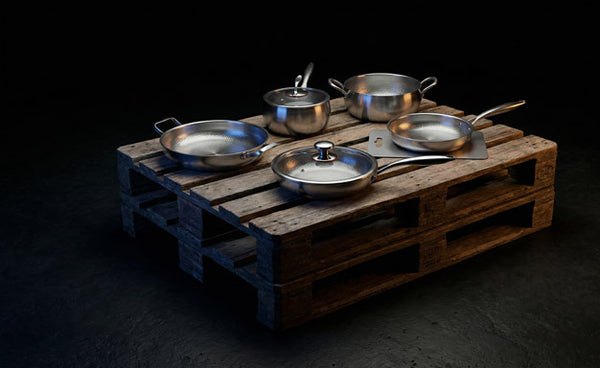
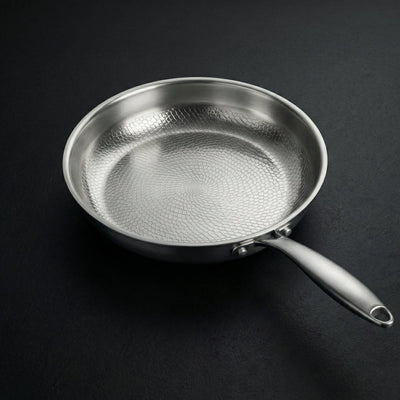
Uncoated grade-1 titanium. No PFAS, no coatings, backed by a 25-year warranty.
Shop the Collection