



Non-Toxic
Best Non-Toxic Bakeware for a Cleaner Kitchen
The best non-toxic bakeware is chosen the same way as safe pans: by looking at the material, not the marketing. Baking sheets, loaf pans, and roasting trays spend long stretches at high heat, so the surface your food touches matters even more than on the stovetop. Here's how to sort the genuinely non-toxic options from the ones that just look the part.
What makes bakeware non-toxic
It comes down to one question: is the surface a solid, stable material, or a coating that can wear and break down in the oven? Non-stick coatings on cheap baking trays are designed to be temporary, and heat accelerates their wear. The safest bakeware skips coatings entirely, so there's no PFAS, PTFE, or PFOA sitting between your food and the pan, and nothing to flake into what you're baking.
Materials worth trusting
- Solid titanium. Biocompatible and inert, uncoated, and comfortable at high oven heat. Nothing to leach, nothing to wear.
- Stainless steel. A safe, uncoated alloy for sheet pans and trays, though it isn't naturally non-stick.
- Cast iron. Bare seasoned iron works well for baking, at the cost of weight and upkeep.
- Ceramic and glass. Uncoated, non-reactive, and fine for baking dishes — though they're heavier and can be fragile.
What to be cautious of
A few common bakeware surfaces deserve a closer look:
- Non-stick coated trays. The convenience fades as the coating wears — and wear is faster at baking temperatures.
- Unlabelled "dark non-stick" sheets. If the surface treatment isn't stated, treat it as a coating.
- Aluminium with no stated finish. Bare aluminium is reactive with acidic foods; look for what, if anything, is on top of it.
Bakeware lives at high heat for long stretches. That's exactly the condition a coating handles worst — and a solid material handles best.
Why solid titanium suits the oven
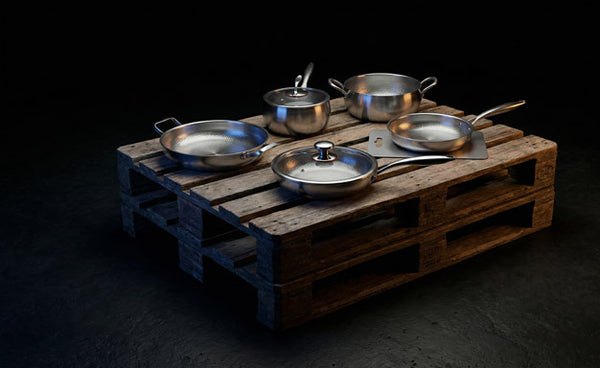
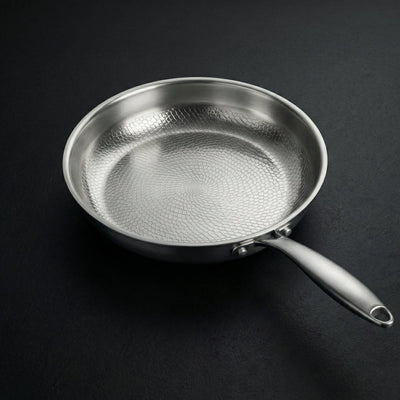
Titanium earns its place here for the same reasons it does on the stovetop. It's biocompatible and inert, with no PFAS, PTFE, lead or cadmium in the surface — so long, hot bakes don't release anything into your food. It handles high heat without a coating's temperature ceiling, moves straight from oven to stovetop, and at roughly 45% lighter than stainless steel it's easy to lift in and out of a hot oven. Because there's no coating on a replacement clock, it's built to last and backed by a 25-year warranty. Our complete non-toxic pans buyer's guide covers the material logic in depth.
The bottom line
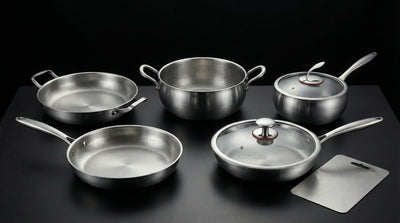
The best non-toxic bakeware is solid and uncoated — titanium, quality stainless, cast iron, ceramic, or glass — so there's nothing to wear off during a long bake. Skip the mystery coatings, especially at oven temperatures, and you've removed most of the risk. To explore solid titanium built for oven-to-stovetop cooking, see our Japanese pans collection, each backed by a 25-year warranty.
The Cookware
Built to Last
Uncoated grade-1 titanium. No PFAS, no coatings, backed by a 25-year warranty.
Shop the Collection