



Non-Toxic
Non-Toxic Pans: The Complete Buyer's Guide
Non-toxic pans are easy to want and surprisingly hard to shop for. The phrase gets stamped on everything, often with no clear definition behind it, so two pans labelled the same way can be built in completely different ways. This guide cuts through that: what "non-toxic" should actually mean, which materials earn the label, and how to pick cookware you can cook on every day without second-guessing it.
What "non-toxic" should mean
A genuinely non-toxic pan is one whose cooking surface does not release anything harmful into your food under normal heat. In practice that comes down to two questions. First, what is the surface made of? Second, is there a coating between your food and the base metal that can wear, flake, or break down over time? The materials people worry about — PFAS, PTFE, PFOA, lead, cadmium — are almost always tied to coatings or low-grade alloys. Rule those out and most of the concern disappears.
The materials worth knowing
A handful of materials have earned lasting trust because they are stable and uncoated:
- Solid titanium — biocompatible and inert. It forms a stable oxide layer that keeps it from reacting with acids, salts, or the everyday chemistry of cooking, and it carries no coating to fail.
- Stainless steel — a workhorse alloy, non-reactive when it is a quality grade, though it lacks natural release.
- Cast iron — bare iron that seasons over time; heavy, and it needs upkeep.
- Carbon steel — similar logic to cast iron, lighter, with the same seasoning routine.
What these share is simple: the surface you cook on is the material itself, not a film sprayed on top of it.
Where coatings complicate things
Most conventional "non-stick" pans are a metal body with a chemical release layer applied on top. The pan is only ever as safe as that coating, and coatings are designed to be temporary. Once they begin to wear, the surface you are cooking on is no longer the surface you bought — and small amounts of the coating can end up in the pan. This is the core reason coated cookware sits at the centre of the non-toxic debate, and why so many people are moving toward solid materials.
If a material was never added to the pan, it can't wear off, flake, or migrate into what you're cooking.
What to look for
Use this as a quick filter when you shop:
- Solid, uncoated surface — no sprayed-on non-stick film.
- No PFAS, PTFE, PFOA, lead or cadmium in the cooking surface, stated plainly.
- Metal-utensil safe — a sign the surface isn't a fragile coating.
- Oven and induction compatible — solid materials usually handle both.
- A long, honest warranty — a maker who expects the pan to last will stand behind it.
Solid titanium as a benchmark
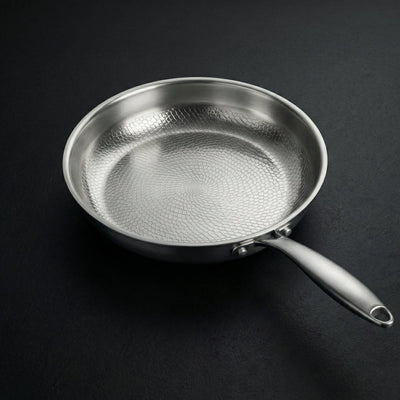
Among uncoated options, solid titanium sets a high bar. It is one of the most biocompatible materials we know of — inert enough that it is trusted for medical implants meant to stay inside the body for decades. In a pan, that stability means it does not react with tomato, citrus, or a long wine reduction, and there is no coating with an expiry date. It is also roughly 45% lighter than stainless steel, so you get durability without the dead weight, and it moves from induction to oven to open flame without drama. If you want the full reasoning, our guide on whether titanium cookware is safe walks through the science.
The bottom line
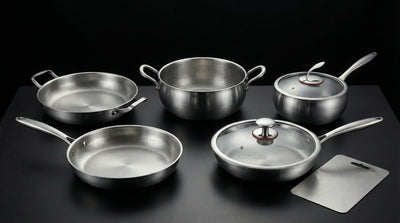
Shopping for non-toxic pans gets simple once you stop reading the label and start reading the build. Favour solid, uncoated materials with nothing between your food and the surface; rule out the coatings and heavy metals that drive the concern; and choose a maker willing to back the pan for the long haul. If you want a starting point, explore our Japanese pans collection — solid titanium, no coatings, backed by a 25-year warranty.
The Cookware
Built to Last
Uncoated grade-1 titanium. No PFAS, no coatings, backed by a 25-year warranty.
Shop the Collection