




Non-Toxic
Best Non-Toxic Stainless Steel Cookware
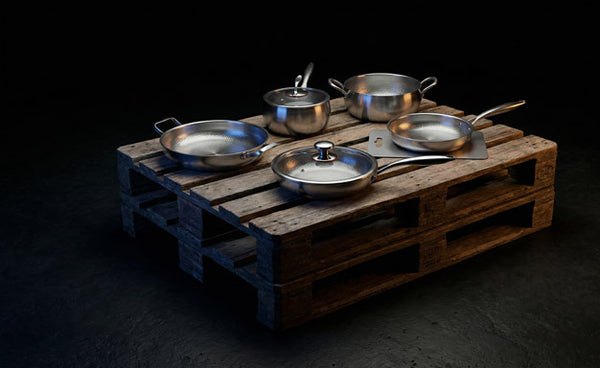
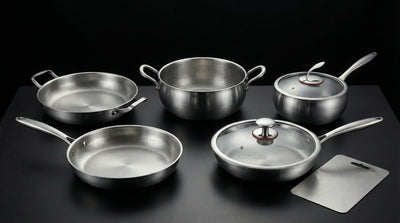
The best non-toxic stainless steel cookware shares a few traits that have nothing to do with brand names and everything to do with how the metal is made and finished. Stainless steel earns its reputation as a safe, uncoated material — but "stainless" covers a wide range of quality, and a few details separate genuinely reassuring cookware from the rest. Here's how to choose, and how solid titanium compares if you want another uncoated option.
Why stainless steel is considered non-toxic
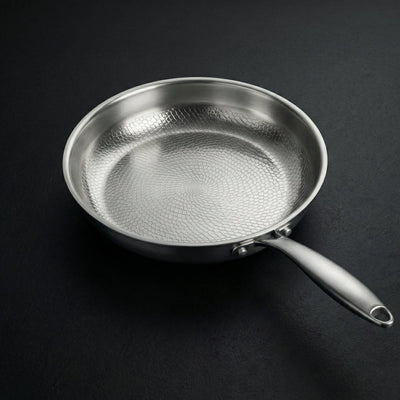
Stainless steel is an alloy — iron blended mainly with chromium and, in better grades, nickel. Its appeal for non-toxic cooking is that the cooking surface is the metal itself, with no chemical coating between your food and the pan. That means no PFAS, no PTFE, no PFOA — the surface can't flake or wear off because there's nothing sprayed on it. For most cooking, quality stainless is stable and non-reactive.
What to look for
Not all stainless is equal. Use these as your filter:
- Grade. Look for food-grade stainless, often marked 18/10 or 18/8 (chromium/nickel). These grades resist corrosion and hold up over years of use.
- Fully clad or solid construction. Better pans use layered (clad) construction for even heat, rather than a thin disc glued to the base.
- No mystery coatings. If a stainless pan is also marketed as non-stick, ask what the non-stick surface actually is — that's usually a separate coating.
- An honest warranty. A maker confident in the metal will stand behind it.
With any uncoated metal, the question isn't "what's the coating made of?" — there is none. It's "how good is the metal?"
The trade-off with stainless steel
Stainless is safe and durable, but it isn't naturally non-stick — food will grip a stainless surface unless you pre-heat well and use enough fat, and it takes practice. It's also relatively heavy, and cheaper grades can develop hot spots. None of that makes it toxic; it's simply the cooking character you're signing up for.
How solid titanium compares
If you're drawn to stainless steel because it's uncoated and stable, solid titanium is worth a look for the same reasons — with a couple of advantages. Titanium is biocompatible and inert, trusted for medical implants, and like quality steel it carries no PFAS, PTFE, lead or cadmium in the cooking surface. Where it pulls ahead: it's naturally non-stick with a properly pre-heated, lightly oiled surface, and it's roughly 45% lighter than stainless steel, so you lose the heft without losing durability. Both are metal-utensil safe and move from induction to oven. For the full picture on choosing safe cookware, see our complete non-toxic pans buyer's guide.
The bottom line
The best non-toxic stainless steel cookware comes down to a quality food-grade alloy, solid or clad construction, and no hidden coatings — the metal does the work, and there's nothing to leach. If you want that same coating-free safety with natural release and far less weight, solid titanium is the alternative worth comparing. Explore it in our Japanese pans collection, backed by a 25-year warranty.
The Cookware
Built to Last
Uncoated grade-1 titanium. No PFAS, no coatings, backed by a 25-year warranty.
Shop the Collection