



Comparisons
Best Titanium Cookware Compared
Shopping for the best titanium cookware gets confusing fast, because two very different products share the name. Some pans are made of solid titanium; many more are ordinary non-stick pans with a coating that contains titanium particles. They perform differently, last differently, and should not be compared like-for-like. Before you can pick the best option for your kitchen, you need to know which kind you are actually looking at. Here is how to tell them apart and what to weigh.
The distinction that changes everything: solid vs titanium-coated
This is the single most important thing to understand when comparing titanium cookware.
- Solid titanium cookware is made from the metal itself — one material, no coating. Its cooking performance and its safety come from the titanium, which is inert and does not wear away.
- Titanium-reinforced or titanium-infused non-stick is a conventional pan (usually aluminium) with a non-stick coating that has titanium particles mixed in for durability. The cooking surface is still a coating, and like all coatings, it is designed to wear out.
Neither is "fake," but they are not the same purchase. A titanium-infused coating is still a coating with a limited lifespan; solid titanium is a buy-it-once material with no film to fail. If long-term value and a coating-free surface are what drew you to titanium in the first place, the difference is the whole point.
What to look for in solid titanium cookware
If you want the real thing, judge it on these:
- Material purity. Look for cookware made from a high grade of titanium rather than a thin titanium layer over another metal.
- No coating. A genuine solid-titanium surface has no sprayed-on non-stick film — nothing to scratch, peel, or replace.
- Safety credentials. Titanium is inert and biocompatible, with no PFAS, PTFE, lead, or cadmium in the cooking surface, so nothing leaches into food.
- Heat range and versatility. Solid titanium handles high heat and moves from induction to oven to flame; check the piece is induction-compatible if you need it.
- Warranty. A long warranty signals the maker expects the pan to last — Okura backs its pans for 25 years.
The first question to ask any "titanium" pan is simple: is the titanium the pan, or is it just in the coating? The answer tells you almost everything.
The honest trade-offs of solid titanium
Solid titanium is excellent, but it is not effortless, and it is fair to say so. It is naturally non-stick through technique and a properly pre-heated surface rather than a slick coating — which means there is a short learning curve, and eggs need a hot pan and a little fat rather than a cold non-stick lift. Titanium also conducts heat less evenly than copper or aluminium, so pans are engineered around that with base construction and pre-heating; give it a minute to come up to temperature and heat evenly, and it performs. And solid titanium sits at a higher price than a cheap coated pan — because you are buying it once rather than every few years.
What you get for those trade-offs: a pan with no coating to wear out, that takes metal utensils, that is remarkably light — titanium is around 45% lighter than stainless steel — and that is not on a replacement cycle. For many cooks that is a straightforward win; for someone who wants a cold-pan non-stick lift with zero technique, a coated pan is easier day to day. Both positions are reasonable.
How to compare your options
Put any two titanium pans side by side and work through the same checklist: solid or coated; what the cooking surface actually is; whether it is free of PFAS and PTFE; whether it goes from induction to oven; how heavy it is; and how long the warranty runs. That sequence cuts through the marketing quickly. A coated pan can be a fine short-term buy at a low price; a solid-titanium pan is the choice when you want to buy once and cook on bare, inert metal for the long run.
The bottom line
The best titanium cookware for you depends on which titanium you mean. If you want convenience at a low upfront cost and are comfortable replacing pans as coatings wear, a titanium-infused non-stick is a reasonable pick. If you want a coating-free, inert surface that lasts and is safe by virtue of the metal itself, solid titanium is the honest answer — and the reason it commands a higher price. For the full safety reasoning, see is titanium cookware safe.
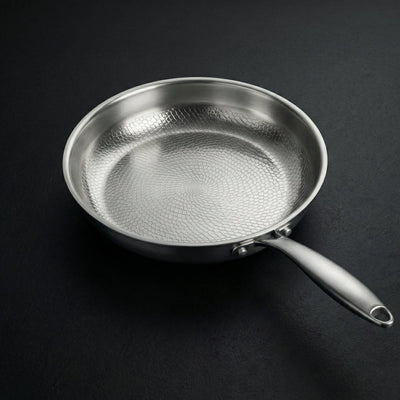
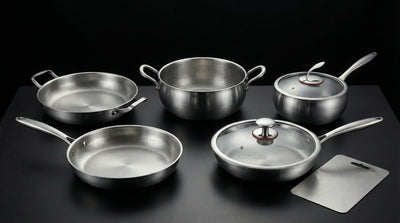
To see solid titanium done properly, explore our Japanese pans collection or start with the hand-hammered titanium pan.
The Cookware
Built to Last
Uncoated grade-1 titanium. No PFAS, no coatings, backed by a 25-year warranty.
Shop the Collection