



Care & How-To
Can You Sharpen a Serrated Knife?
Can you sharpen a serrated knife? Yes — and despite what many people assume, you do not have to throw it out when it goes dull. Serrated blades just need a different approach from a straight edge: instead of running the whole edge across a flat stone, you sharpen the scallops one at a time with a tapered rod. It is slower and more fiddly than sharpening a chef's knife, but it is entirely doable at home. Here is how it works.
Why serrated knives are different
A serrated edge is a row of small scalloped grooves (the gullets) with pointed teeth between them. That shape is what lets a bread knife saw through a crusty loaf or a ripe tomato without crushing it. But it also means a flat whetstone is the wrong tool: press a serrated edge onto a flat stone and you grind down the tips of the teeth while never touching the curved grooves that actually do the cutting. To sharpen the edge, you have to get into each groove — which calls for a rod that matches its curve.
What you need
The right tool is a tapered sharpening rod, sometimes sold as a serrated knife sharpener or a ceramic honing rod. Because it tapers from thick to thin along its length, you can slide it along until the diameter matches the groove you are working on. A fine, tapered ceramic or diamond rod is ideal. You do not need a full stone set — just the rod, good light, and a little patience.
How to sharpen a serrated knife, step by step
- 1. Find the bevelled side. Most serrated knives are ground on one side only; the other is flat. You sharpen the bevelled (angled) side.
- 2. Match the rod to the groove. Slide the tapered rod into the first scallop until it fills the groove snugly, and align it to the existing bevel angle.
- 3. Stroke outward, groove by groove. Draw the rod along the bevel with light pressure, moving away from the blade, a few strokes per groove. Work down the whole edge one scallop at a time.
- 4. Remove the burr. When you have done every groove, you will feel a slight burr on the flat back of the blade. Lay the rod or a fine stone flat against that back and make one or two gentle passes to knock it off.
- 5. Test carefully. Slice a piece of bread or paper. It should catch and cut cleanly.
You are not reshaping the blade — you are just restoring the bevel inside each tooth. Light pressure, one groove at a time.
How often, and when to leave it
Serrated knives hold their edge far longer than straight blades — the points do most of the work and stay protected — so they need sharpening only occasionally, often once a year or less for a home bread knife. If a knife is badly chipped, or the serrations are worn almost flat, a professional sharpening service with the right equipment is the sensible call rather than fighting it by hand. For a normally dull serrated edge, though, the rod method above brings it back.
Straight edges are simpler
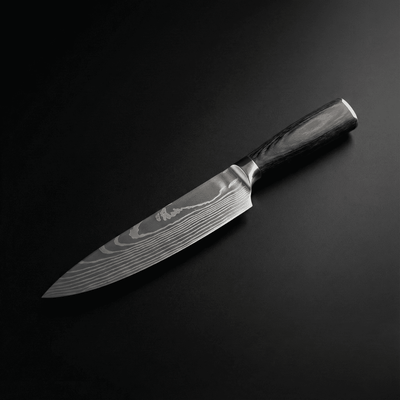
If all this sounds like effort, it is worth remembering that a plain straight-edged knife is much easier to maintain — a stone and a few minutes and it is sharp again. Many cooks keep one serrated knife for bread and rely on straight-edged Japanese knives for nearly everything else, precisely because they are so quick to sharpen at home. If you sharpen your straight knives on stones, our whetstone grit chart shows which grit to use.
Building a set you can keep sharp for decades? Explore our Japanese chef's knives.
The Cookware
Built to Last
Uncoated grade-1 titanium. No PFAS, no coatings, backed by a 25-year warranty.
Shop the Collection