



Japanese Knives
Damascus Chef Knife: Buyer's Guide
A Damascus chef knife is one of the most striking tools you can put on a kitchen counter — those rippling, watermarked lines have a way of stopping people mid-conversation. But there is real substance behind the looks, and a few myths worth clearing up. This buyer's guide explains what Damascus actually is, what it does for a knife, and how to choose one well.
What "Damascus" really means
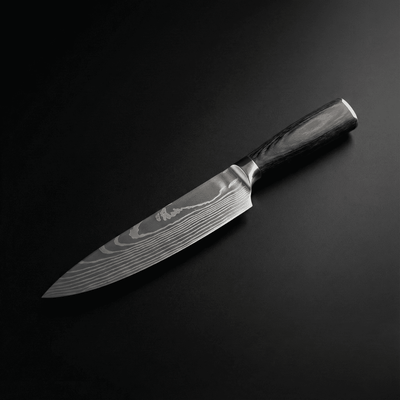
Damascus refers to a construction method, not a type of knife or a grade of steel. The blade is built from multiple layers of steel forged and folded together, then finished so the boundaries between layers show as a flowing, organic pattern. That is why you will see Damascus gyutos, santokus and nakiris — the word describes how the blade is made and how it looks, not the job it does.
Damascus is not a knife type. It is a way of building a blade — layered steel that leaves a pattern you can see.
Pattern versus performance
Here is the honest part most sellers skip: on a modern kitchen knife, the Damascus pattern is primarily aesthetic. The layers you see on the outside are usually softer, decorative steel wrapped around a harder core that does the actual cutting. What determines how well the knife performs is that core steel and the quality of the edge — not the number of visible layers. A beautiful pattern on a poorly finished blade is just a beautiful blade that cuts poorly.
So treat the pattern as what it is: a genuinely attractive finish, and a sign of craftsmanship when it is done well — but not, on its own, proof of a better cut.
What to look for when buying
- Edge and geometry. A thin, keen, well-ground edge is what makes any knife cut. This matters more than layer count.
- Core steel. The cutting core, not the cladding, drives edge retention. Look for a hard, well heat-treated core.
- Balance and handle. The knife should feel settled in your grip, not tip-heavy or handle-heavy.
- Honest description. Be wary of listings that sell only the pattern and say nothing about the steel or the edge.
Living with a Damascus knife
A Damascus finish needs the same care as any fine knife, with one note: keep it dry and clean, cut on wood rather than glass or stone, and hone regularly. The etched pattern is on the surface, so treat the blade gently and it will keep its looks as well as its edge. Hand wash and dry it rather than trusting a dishwasher, where heat and detergent can dull both the edge and the finish.
Which shape should it be?
Because Damascus is a construction rather than a shape, the first decision is still which knife you want — an all-purpose chef's knife, a vegetable nakiri, and so on. Choose the shape for the job, then decide whether you want it in a Damascus finish. Our Japanese knife types guide covers the shapes, so you can match form to function first.
The bottom line
A Damascus chef knife can be a superb tool and a beautiful object at once — as long as you buy it for the edge and the steel, and enjoy the pattern as the finishing touch. Judge the cut first and the looks second. See the range in our chef's knives collection, each backed by a 25-year warranty.
The Cookware
Built to Last
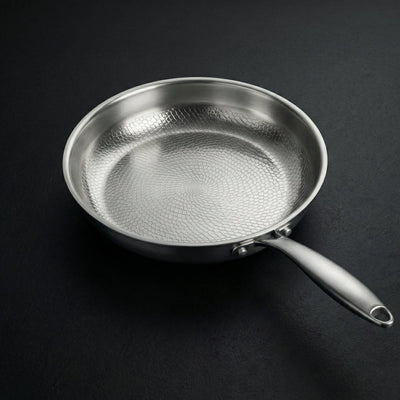
Uncoated grade-1 titanium. No PFAS, no coatings, backed by a 25-year warranty.
Shop the Collection