



Japanese Knives
Japanese Knife Types Explained
Japanese knives have a reputation for precision, and once you understand the main Japanese knife types the reason becomes obvious: each shape was refined for a specific job rather than compromised into a do-everything blade. This guide walks through the knives that matter most in a home kitchen, what each one is built for, and how to tell which belongs in your hand.
What makes a knife "Japanese"
Japanese kitchen knives tend to favour thinner blades, harder steel and a more acute cutting edge than the heavier European style. The payoff is a cleaner, more effortless cut; the trade-off is a knife that rewards proper technique and care. Most modern Japanese knives you will meet are double-bevelled — sharpened on both sides like a Western knife — which makes them approachable for anyone, whether right- or left-handed. A smaller number of traditional shapes are single-bevelled and aimed at specialists.
A Japanese knife is not one thing. It is a family of shapes, each solving a different problem on the cutting board.
Gyuto — the all-purpose chef's knife
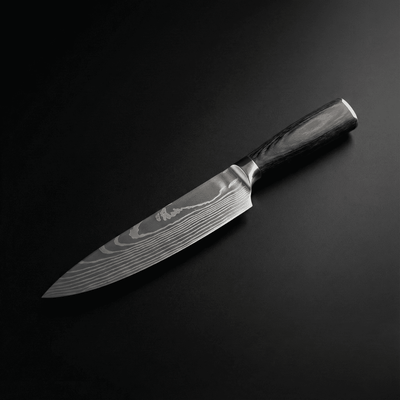
The gyuto is the Japanese take on the Western chef's knife, and it is the most versatile blade in the family. Its gently curved edge lets you rock through herbs, slice proteins and break down produce with one tool. If you only add a single Japanese knife to your kitchen, this is usually the one. We go deeper in our guide to the gyuto knife.
Santoku — the compact everyday knife
Santoku means "three virtues," a nod to its comfort with meat, fish and vegetables. It is shorter than a gyuto with a flatter edge and a rounded tip, which makes it feel nimble and confidence-inspiring for cooks who prefer a straight up-and-down chop to a rocking motion. It is a natural first Japanese knife for many home kitchens.
Nakiri — the vegetable specialist
The nakiri is unmistakable: a flat, rectangular blade built almost entirely for vegetables. That straight edge meets the board along its whole length, so a single push cut goes cleanly through an onion or a stack of greens without the half-connected slices a curved blade can leave. If you do a lot of plant-forward cooking, it is a revelation — more in our guide to the nakiri knife.
Petty — the small utility knife
"Petty" comes from the French petit, and that is exactly what it is: a small utility knife for the jobs too fiddly for a big blade. Peeling, trimming, segmenting citrus, slicing shallots in the hand — the petty handles the detail work that would feel clumsy with a full chef's knife.
What about "Damascus"?
One term that causes confusion: Damascus is not a knife type. It describes a construction — layers of steel forged together to leave a flowing, watermarked pattern on the blade. A gyuto, a santoku or a nakiri can all be made with a Damascus finish. It is about how the blade is built and how it looks, not the job it does; see our Damascus chef knife guide for the detail.
Single-bevel specialist knives
Beyond the everyday shapes sit the traditional single-bevel knives, sharpened on one side for very fine, specific work — the long yanagiba used for slicing fish for sashimi, or the deba used to break down whole fish. They are superb at their jobs and demand dedicated sharpening skill, which is why most home cooks start with double-bevel knives and add a specialist later.
How to build a set
You do not need one of everything. Most kitchens are covered by a versatile main knife, a vegetable knife and a small utility knife — a combination that handles the overwhelming majority of prep. If you would rather choose a coordinated group than assemble one piece at a time, our guide to choosing a Japanese knife set walks through the logic.
The bottom line
The Japanese knife types come down to matching a shape to a task: a gyuto or santoku for everyday cooking, a nakiri for vegetables, a petty for detail, and Damascus as a construction that can dress any of them. Choose by the food you actually cook and the knife will feel like an extension of your hand. Browse the range in our chef's knives collection, each backed by a 25-year warranty.
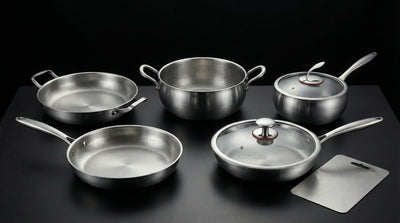
The Cookware
Built to Last
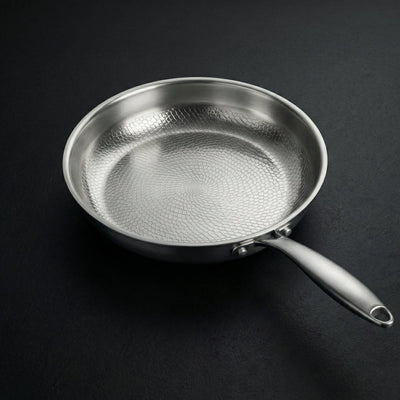
Uncoated grade-1 titanium. No PFAS, no coatings, backed by a 25-year warranty.
Shop the Collection