



Non-Toxic
Does Parchment Paper Have PFAS?
Does parchment paper have PFAS? For most kitchen parchment, the answer is no — but "most" isn't "all," and the honest answer depends on how a given paper is made non-stick. Because parchment is disposable and touches food at high heat, it's a fair thing to check. Here's what parchment is actually coated with, when PFAS can enter the picture, and how to shop with confidence.
What makes parchment non-stick
Parchment paper is treated so food and grease don't soak through or stick. The most common treatment on modern baking parchment is a thin layer of silicone, which is a silicon-based material, not a PFAS chemistry. Some papers use an alternative coating instead. The label term to look for is "silicone-coated" or "unbleached, silicone-coated" parchment.
Where PFAS can come in
PFAS — per- and polyfluoroalkyl substances — are prized industrially for repelling grease and water, which is exactly why they've historically shown up in some grease-resistant paper products. Silicone-coated baking parchment generally isn't where the concern lives, but not every "parchment" or greaseproof paper is silicone-coated, and coatings aren't always disclosed. That's the reason the question is worth asking rather than assuming.
The safe move isn't panic — it's reading the label. A paper that states "silicone-coated" and "PFAS-free" has answered the question for you.
How to check what you're buying
- Look for "PFAS-free" stated plainly. Reputable brands increasingly say so.
- Look for "silicone-coated." That tells you what the non-stick treatment is.
- Be cautious with vague "greaseproof" paper. If the coating isn't named, you can't confirm what it is.
- Unbleached isn't the same as PFAS-free. Bleaching and PFAS are separate issues — check for both if they matter to you.
If you'd rather skip the paper
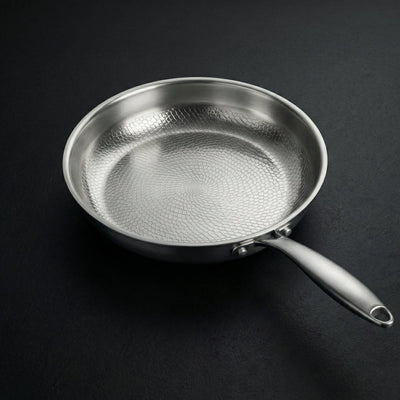
The most reliable way to avoid the question entirely is to bake and cook on a surface that needs no liner at all. A solid, uncoated cooking surface has nothing to leach because there's no coating in the first place — the same logic that makes people wary of PFAS applies in reverse. Solid titanium, for example, is biocompatible and inert, carries no PFAS, PTFE, lead or cadmium in the surface, and is naturally non-stick with a pre-heated, lightly oiled surface — so you can often skip the parchment altogether. Our complete non-toxic pans buyer's guide explains how to choose cookware on the same principle.
The bottom line
Does parchment paper have PFAS? Usually not — most baking parchment is silicone-coated — but because coatings aren't always disclosed, look for a paper that states "PFAS-free" and "silicone-coated." And if you'd rather not think about liners at all, a solid uncoated cooking surface sidesteps the question. Explore coating-free solid titanium in our Japanese pans collection, backed by a 25-year warranty.
The Cookware
Built to Last
Uncoated grade-1 titanium. No PFAS, no coatings, backed by a 25-year warranty.
Shop the Collection