






Non-Toxic
Does Silicone Contain PFAS?
Does silicone contain PFAS? No — food-grade silicone and PFAS are two different chemistries, and one is not the other. The confusion is understandable, because both get grouped under "modern non-stick materials," but they're built from entirely different building blocks. Here's the clear version, plus what to actually check on silicone kitchenware.
Two different materials
PFAS — per- and polyfluoroalkyl substances — are defined by carbon-fluorine bonds. They're the family behind certain non-stick coatings and grease-repellent treatments, and they're persistent in the environment, which is why they draw scrutiny.
Silicone is different. Food-grade silicone is a silicon-oxygen polymer derived from silica — essentially refined from sand. It contains no fluorine and isn't part of the PFAS family. So a silicone spatula or baking mat isn't "PFAS with another name"; it's a separate material entirely.
PFAS are built on carbon-fluorine bonds. Silicone is built on silicon and oxygen. Same drawer in your kitchen, completely different chemistry.
So is silicone automatically fine?
Being PFAS-free is one question; overall quality is another. A few sensible checks on silicone kitchenware:
- Choose food-grade silicone. It's the standard for items that touch food.
- Watch for fillers. Cheap silicone can contain non-silicone fillers; a quick "pinch test" (twisting a flat surface — white streaks can indicate fillers) is a common rough check.
- Keep it within its heat range. Quality silicone tolerates oven heat, but every product has a stated limit.
None of that changes the core answer — silicone doesn't contain PFAS — but it helps you buy good silicone rather than the cheapest available.
Where this matters for cookware
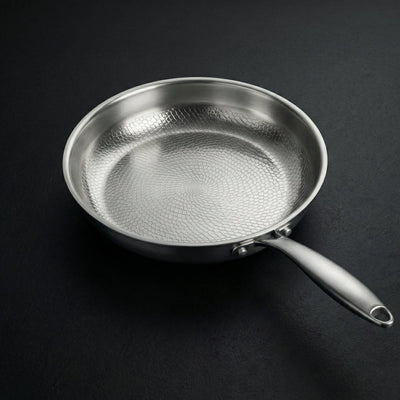
The bigger PFAS concern in the kitchen isn't silicone utensils — it's the non-stick coatings on some pans, where PFAS-based chemistries have traditionally been used. That's the surface your food sits on at heat, day after day. The cleanest way around it is cookware with no coating at all: if there's no coating, there's nothing to leach. Solid titanium is a good example — biocompatible and inert, with no PFAS, PTFE, lead or cadmium in the cooking surface, and naturally non-stick with a pre-heated, lightly oiled pan. Our complete non-toxic pans buyer's guide walks through how to choose on that principle.
The bottom line
Does silicone contain PFAS? No — food-grade silicone is a silicon-oxygen material with no fluorine, chemically distinct from the PFAS family. Buy quality food-grade silicone and it's a sound choice. And if you want to remove coating-related PFAS worries from your cookware entirely, a solid uncoated surface has nothing to leach. Explore coating-free solid titanium in our Japanese pans collection, backed by a 25-year warranty.
The Cookware
Built to Last
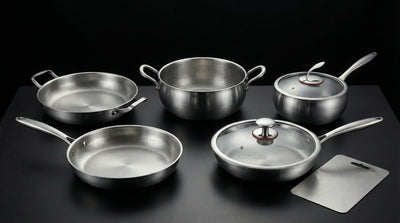
Uncoated grade-1 titanium. No PFAS, no coatings, backed by a 25-year warranty.
Shop the Collection