



Care & How-To
Honing vs Sharpening: What's the Difference
Most people use the words interchangeably, but honing vs sharpening describes two completely different jobs. One realigns an edge that has bent slightly out of shape; the other grinds a new edge when the old one has genuinely worn down. Confusing them is the reason so many home cooks think their knives are dull when they are really just crooked. Here is the difference, and when to do each.
The short answer
Honing straightens an edge; sharpening creates a new one. Honing — done with a honing rod, often called a "steel" — pushes a rolled edge back into alignment and takes off almost no metal. Sharpening, done on a whetstone or similar abrasive, actually removes metal to grind a fresh, keen edge. You hone often and sharpen rarely. Both keep a knife performing, but they are not the same task and one does not replace the other.
What honing actually does
A knife edge is incredibly thin, and with normal use that fine edge rolls over microscopically to one side — a bit like the bristles of a toothbrush leaning after a while. The knife still has plenty of sharp steel; it is just no longer pointing straight, so it feels dull. Running the blade along a honing rod pushes that rolled edge back into line, and the knife feels sharp again instantly. Nothing is ground away — you are straightening, not grinding. That is why you can hone before nearly every use without wearing the knife down.
What sharpening actually does
Eventually, no amount of straightening helps, because the very edge has worn away and rounded off. That is when you sharpen. Sharpening uses an abrasive — a whetstone is the gold standard — to grind away a thin layer of steel and form a brand-new edge. Because it removes metal, sharpening is something you do occasionally, not routinely. Done well, it resets the blade to genuinely sharp; done too often or too aggressively, it wears the knife down faster than necessary.
Honing is maintenance you do all the time. Sharpening is a reset you do now and then. One keeps a good edge good; the other brings a lost edge back.
Why the difference matters
Get these two mixed up and you either neglect your knives or over-grind them. People who never hone let their edges roll and then assume the knife is worn out, when a few passes on a rod would have fixed it. People who reach for a whetstone every week wear their blades down long before they need to. Knowing which job the knife actually needs — a quick straighten or a real regrind — is what keeps an edge keen for years without unnecessary wear.
How often should you do each?
- Honing: frequently — many cooks give the blade a few passes before each use or every few uses. It is fast, gentle, and keeps the edge true.
- Sharpening: occasionally — perhaps every month or two of regular home use, or whenever honing no longer restores the bite. It is slower and removes metal, so you do it only when needed.
When to hone and when to sharpen
Hone when the knife was sharp recently and has started to feel like it is dragging — that is almost always a rolled edge. Sharpen when honing stops making a difference, when the edge visibly reflects light along its length (a sign it has rounded off), or when the knife struggles with a task it used to breeze through. In practice, regular honing means you sharpen far less often, because you are keeping the edge true instead of letting it deteriorate.
The tools for each
For honing you want a honing rod and the habit of using it — our guide on how to use a honing rod covers the technique. For sharpening you want a whetstone, which gives you the control to set a proper edge; our guide to sharpening a knife on a whetstone covers the full method. Together, the rod and the stone are all the maintenance most kitchens ever need.
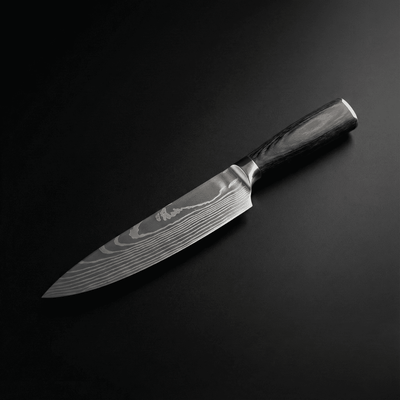
Both matter most on a knife worth maintaining — good steel holds the edge you work to give it. See what that feels like in our chef's knives collection.
The Cookware
Built to Last
Uncoated grade-1 titanium. No PFAS, no coatings, backed by a 25-year warranty.
Shop the Collection