



Care & How-To
How to Sharpen a Knife Without a Sharpener
Need to know how to sharpen a knife without a sharpener? It is genuinely possible with things already in your kitchen — a ceramic mug, a sheet of sandpaper, even a smooth stone. None of these will match a proper whetstone, but any of them will bring a dull blade back to usable in a pinch. Here is what actually works, and what to skip.
The short answer
Any hard, slightly abrasive surface can grind a fresh edge onto a knife if you hold a consistent angle and work both sides evenly. The unglazed ceramic ring on the bottom of a mug is the best improvised option most people have. Sandpaper on a flat surface is the next best. These are stop-gaps to get you through — for a lasting, keen edge, a whetstone is still the tool you want.
Method 1: The bottom of a ceramic mug
Flip a mug or bowl upside down. That rough, unglazed ring around the base is abrasive enough to act as a makeshift sharpening stone.
- Set the mug on a stable surface, base up.
- Hold the knife at a low, steady angle against the ring — roughly 15 to 20 degrees, about the width of two stacked coins between the spine and the surface.
- Draw the edge across the ring from heel to tip, as if slicing a thin layer off it, using light pressure.
- Do the same number of strokes on each side until the blade bites again.
The ceramic is genuinely hard, so this works better than most people expect. Wipe the grey marks off the mug afterwards.
Method 2: Sandpaper on a flat surface
A sheet of wet-and-dry sandpaper laid on something flat — a countertop, a glass chopping board, a book — makes a surprisingly effective improvised stone. Start with a medium grit to reset the edge and finish on a finer one to refine it. Wet the paper lightly, hold your angle, and draw the edge across leading with the blade, alternating sides. It mimics a whetstone closely and gives more control than the mug method.
Every improvised method comes down to the same two things: a consistent angle and even work on both sides. Get those right and almost any hard, gritty surface will sharpen a blade.
A note on honing rods and "steels"
If you have a honing rod in a knife block, know that it does not sharpen. A rod straightens an edge that has rolled slightly out of true — it realigns metal rather than removing it. On a genuinely dull knife it will do very little. It is worth using regularly to keep a sharp edge keen, but it is not a substitute for actual sharpening. That is a common and understandable mix-up.
What to avoid
- Glass edges, concrete and random rough stone — these can gouge the edge unevenly and do more harm than good.
- Pull-through "sharpeners" if you own a good knife — they hog off metal at a fixed, aggressive angle and shorten the blade's life.
- Heavy pressure. Sharpening is about angle and repetition, not force. Pressing hard just rounds the edge or chips it.
- Sharpening a knife you can simply hone. If the edge is only slightly dull, a rod may be all it needs.
The honest truth
Improvised methods are for emergencies: a dull knife, a meal to cook, and no proper kit to hand. They work, and it is worth knowing them. But a good knife deserves a good edge, and nothing improvised matches a whetstone for control, finish and how long the result lasts. If you find yourself reaching for the mug more than once, that is the sign to learn the proper method — our step-by-step guide to sharpening a knife on a whetstone walks through the whole thing.
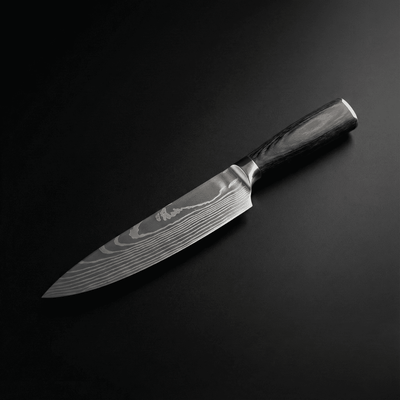
And if the knife itself is the problem — soft steel that dulls after a few uses no matter how you sharpen it — the fix is a better blade. See what a knife that holds its edge feels like in our chef's knives collection.
The Cookware
Built to Last
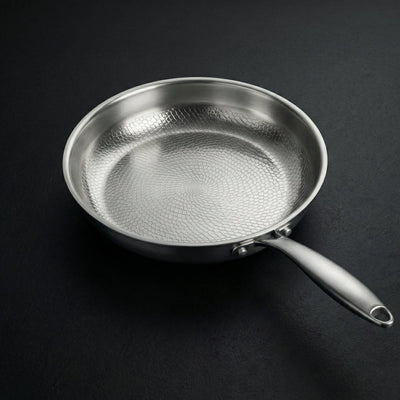
Uncoated grade-1 titanium. No PFAS, no coatings, backed by a 25-year warranty.
Shop the Collection