



Titanium Safety
Is a Titanium Non-Stick Pan Actually Non-Stick?
A titanium non-stick pan sounds like it should behave like the coated pan in your cupboard — but the way it releases food is fundamentally different, and understanding that difference is the key to getting it right. The short version: solid titanium is naturally non-stick, but its release comes from the surface and your technique, not from a sprayed-on film. Here is what that means in practice.
Two very different kinds of "non-stick"
Most pans labelled non-stick are a metal body with a chemical coating on top. That coating gives effortless release on day one — and a countdown timer. As it wears, performance drops and small amounts can flake into your food, which is why coated pans get replaced every few years.
Solid titanium works differently. There is no coating. Its release comes from a properly pre-heated, lightly oiled surface and the natural behaviour of the metal. That means it doesn't have the zero-effort, cold-pan release of a fresh coating — but it also has no coating to wear out, so it doesn't stop being non-stick after a few years.
How to actually get non-stick results
Titanium rewards a simple routine. Get it right and food releases cleanly; skip it and you'll fight sticking.
- Pre-heat properly. Give the pan a minute or two over medium heat before anything goes in. A cold titanium pan sticks; a hot one doesn't.
- Add a little fat. A thin film of oil or butter is all it takes. Titanium is naturally non-stick, not zero-fat.
- Let food form a crust. Proteins release themselves once they've seared. If it's stuck, it usually isn't ready to turn yet.
- Don't overcrowd. Steam is the enemy of a clean release; give ingredients room.
Coated pans release because of a film. Titanium releases because of heat and technique — which is why it never expires.
Why no coating is the point
The absence of a coating isn't a compromise — it's the whole advantage. A solid titanium pan has no PFAS, PTFE, PFOA, lead or cadmium in the cooking surface, so there is nothing to leach into your food and nothing to flake off. Titanium itself is biocompatible and inert, trusted for medical implants because it doesn't react with the body. In a pan, it doesn't react with tomato, citrus, or a long reduction either. You can read the full reasoning in our guide on whether titanium cookware is safe.
Metal utensils, high heat, and the oven
Because there's no coating to protect, a titanium pan handles the things coated pans can't. Use metal utensils without worrying about scratches. Take it to high heat without a coating's temperature ceiling. Move it from induction to oven to open flame. And at roughly 45% lighter than stainless steel, it does all of that without the heft of cast iron.
The bottom line
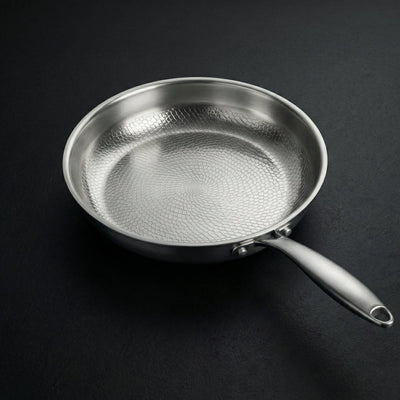
Is a titanium non-stick pan actually non-stick? Yes — with a properly pre-heated surface and a little fat, food releases cleanly, and unlike a coated pan, that performance doesn't fade because there's no coating to wear out. It asks for a small change in habit and gives you a surface that lasts. See it in the hand-hammered titanium pan, backed by a 25-year warranty.
The Cookware
Built to Last
Uncoated grade-1 titanium. No PFAS, no coatings, backed by a 25-year warranty.
Shop the Collection