



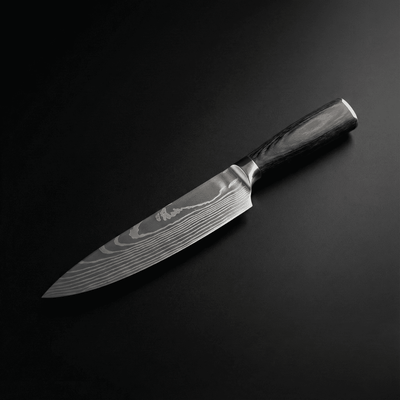
Japanese Knives
Japanese Utility (Petty) Knife: What It's For
A Japanese utility knife — usually called a petty knife — is the small, sharp blade that fills the gap between a big chef's knife and a little paring knife. It is the one you grab for the dozens of small jobs that a full-size knife makes clumsy and a paring knife makes slow. Underrated and endlessly useful, it is often the second knife people wish they had bought first. Here is what it does and why it earns its place.
The short answer
A petty knife is a compact, agile utility knife built for precision tasks: trimming, peeling, slicing shallots, segmenting citrus, cleaning herbs, and any detail work that a large blade handles awkwardly. Think of it as a paring knife with more reach and a chef's knife with more finesse — the in-between size that turns out to be the one you use constantly.
What "petty" actually means
"Petty" comes from the French petit, meaning small, and that is exactly what it is: a scaled-down all-purpose knife. In a Japanese kitchen it sits just below the gyuto and santoku in size. The blade is long enough to slice properly on a board but short and nimble enough to use in your hand, off the board, the way you would a paring knife. That dual nature — board work and in-hand work — is the whole point of the shape.
What a petty knife is for
The petty shines at the small, fiddly tasks that make up more of cooking than we admit:
- Peeling and trimming fruit and vegetables
- Slicing shallots, garlic and small produce with control
- Segmenting citrus and coring tomatoes
- Cleaning and mincing herbs
- Slicing cheese, cured meats or a sandwich
- Detail work where a big knife feels like overkill
None of these are jobs a chef's knife can't do — they are jobs a chef's knife does awkwardly. The petty makes them quick and comfortable.
A petty knife is the one that lives on the counter. Not because it does one thing better than everything else, but because it does the small things effortlessly.
Where it beats a chef's knife
A full-size chef's knife is built for volume and reach, which makes it heavy and imprecise for small tasks. Trying to hull a strawberry or peel an apple with a long blade is more effort than it should be. The petty's shorter, lighter blade gives you fine control for exactly that kind of work — you can steer the tip precisely and work in your hand rather than being tied to the board.
Where it beats a paring knife
A paring knife is even smaller, and its short blade runs out of length the moment you need to slice something with any size to it. The petty's extra reach lets it do real board work — slicing a shallot into neat rings, cutting a sandwich, portioning a block of cheese — that a paring knife is simply too short for. It is the more versatile of the two, which is why many cooks find the petty quietly replaces their paring knife in daily use.
Do you actually need one?
If you own a chef's knife or santoku and nothing else, a petty is the most useful second knife you can add — more so, for most people, than a bread knife or a cleaver. It covers the precision end of the kitchen the way your big knife covers the heavy end, and together the two handle the vast majority of what you cook. If you already have a paring knife and find it too small more often than not, the petty is the upgrade.
Choosing a petty knife
Look for good steel that takes and holds a fine edge — precision work depends on sharpness more than anything else — and a size that feels balanced in your hand. As with any Japanese knife, keep it off bone and frozen food, cut on wood or plastic, and hone it regularly, and it will stay keen for years.
See the range in our chef's knives collection, and if you are still deciding which blades your kitchen actually needs, our guide to Japanese knife types lays out where the petty fits alongside the gyuto, santoku and nakiri.
The Cookware
Built to Last
Uncoated grade-1 titanium. No PFAS, no coatings, backed by a 25-year warranty.
Shop the Collection