



Japanese Knives
Nakiri vs Santoku: Key Differences
Put a nakiri vs santoku side by side and they can look like cousins — both are compact Japanese knives with tall, flat-ish blades. Use them, though, and the difference is obvious. One is a specialist built almost entirely around vegetables; the other is an all-rounder that handles most of what a kitchen throws at it. Here is how they differ and which one deserves a spot on your board.
The short answer
A nakiri is a dedicated vegetable knife: a straight, rectangular blade with a blunt tip, made for clean, straight-down cuts through produce. A santoku is a general-purpose knife: a slightly curved, pointed blade that handles vegetables, meat and fish alike. If you do huge volumes of vegetable prep, the nakiri is a revelation. If you want one knife for nearly everything, the santoku wins.
What a nakiri is built for
The nakiri exists for one thing and does it beautifully: cutting vegetables. Its tall, perfectly straight edge meets the board along its whole length, so a single push slices clean through a carrot, a cabbage or a stack of herbs without the last uncut sliver you get from a curved blade. The height gives your knuckles clearance and makes it easy to guide, and the flat profile makes uniform cuts almost automatic. The trade-off is focus — the blunt, square tip means the nakiri is not the knife for piercing, trimming meat, or detail work.
What a santoku is built for
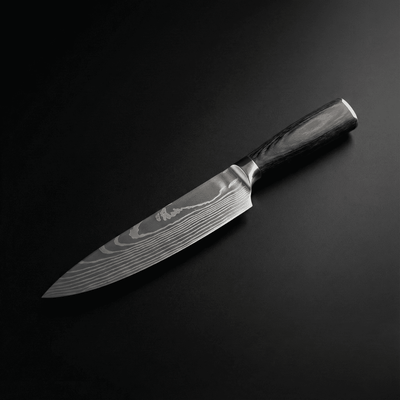
The santoku is the everyday knife. Its name means "three virtues" — a reference to how comfortably it moves between meat, fish and vegetables. The blade is a little shorter than a chef's knife, with a mostly flat edge that curves gently up to a rounded point. That shape lets it chop cleanly like a nakiri for most vegetable work, while the pointed tip and versatility let it slice proteins and handle jobs the nakiri simply cannot. It is the knife you reach for when you only want to reach for one.
The nakiri is a specialist that outperforms on vegetables; the santoku is a generalist you can use for almost anything. Your prep decides which matters more.
Blade shape and the cutting motion
Both knives favour a straight up-and-down or gentle push cut rather than the rocking motion of a Western chef's knife. The nakiri takes that further — its edge is dead flat, so every cut lands the full length of the blade on the board. The santoku's slight curve near the tip gives up a little of that flatness in exchange for versatility and a usable point. In practice, the nakiri feels marginally cleaner on dense vegetables, while the santoku feels more adaptable across a whole meal.
One job vs three
Think about what fills your cutting board. If most of your cooking is plant-forward — big batches of vegetables, stir-fries, salads, meal prep — a nakiri turns that work into something fast and satisfying. If your prep is varied, with meat and fish alongside produce, and you would rather own one knife that covers it all, the santoku is the smarter first buy. Many cooks eventually own both, using the santoku as the daily driver and the nakiri when vegetables take over the menu.
Which should you buy?
- Choose a nakiri if you cut a lot of vegetables and want clean, uniform slices with almost no effort.
- Choose a santoku if you want one versatile knife for meat, fish and vegetables.
- Buy both if you cook often — they cover different jobs and rarely step on each other.
Whichever you choose, the value is in the steel and the edge. A well-forged Japanese blade stays sharp longer and makes every cut feel easier, which is what separates a knife you tolerate from one you enjoy. See the santoku in the santoku knives collection, and if you are still mapping out your kit, our overview of Japanese knife types shows how the nakiri, santoku and the rest fit together.
The Cookware
Built to Last
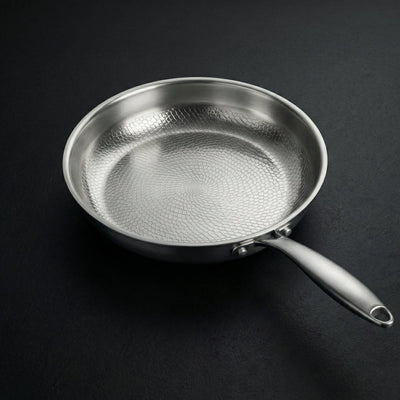
Uncoated grade-1 titanium. No PFAS, no coatings, backed by a 25-year warranty.
Shop the Collection