



Non-Toxic
Non-Toxic Cutting Boards: What to Actually Look For
Search for a non-toxic cutting board and you will find plenty of marketing and very little straight talk. A cutting board sits under everything you eat, gets scored by a blade thousands of times, and rarely gets replaced — so what it is made of genuinely matters. Here is what actually makes a board non-toxic, and how the common materials compare once you look past the label.
What "non-toxic" actually means for a cutting board
A board earns the term by not adding anything to your food. In practice that comes down to three things: the material itself is inert and food-safe, it does not shed particles into what you cut, and it is not treated with finishes or adhesives that can migrate. Every honest assessment of a cutting board comes back to those three questions. The marketing word is "non-toxic"; the real test is whether the board is made of something stable that stays put.
The three things to check
- Material safety: is the surface itself food-safe and stable, or a cheap composite you know little about?
- Microplastics: does the board shed tiny particles into your food as the knife scores it?
- Finishes and glues: is there a coating, dye, or adhesive that can break down and leach over time?
Plastic boards and microplastics
Plastic is cheap, light, and dishwasher-safe, which is why it is everywhere. The problem is what a knife does to it. Every cut leaves a groove, and those grooves are plastic that had to go somewhere — some studies have pointed to plastic cutting boards as a possible source of microplastics in home-prepared food. A scored, heavily used plastic board is also hard to get properly clean, because bacteria settle into the knife marks. It is not that plastic is dramatic or dangerous overnight; it is that it wears into your food a little at a time.
A cutting board should stay on the board. The moment it starts ending up in your food, "non-toxic" stops being true.
Wood boards: better, with upkeep
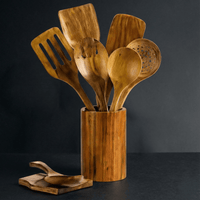
Wood is the traditional answer and a good one. Solid hardwood is a natural material, and its structure has some ability to draw bacteria below the surface where they die off. But wood is not maintenance-free. It has to be oiled to stay sealed, it can crack or warp if it is left wet or run through a dishwasher, and cheaper "wood" boards are often glued composites held together with adhesives you cannot see. A well-kept solid wood board is a genuinely non-toxic option; a neglected or cheaply bonded one is a different story.
A word on bamboo and composite boards
Bamboo often gets sold as the eco-friendly choice, and the material itself is fine — but bamboo boards are made by gluing strips together, so the board is only as clean as the adhesive holding it. The same caution applies to any "wood composite" or resin-bonded board: the question is not only the surface material but everything bonded beneath it. If a board does not say what it is made of and how it is held together, treat that silence as an answer.
Where solid titanium fits
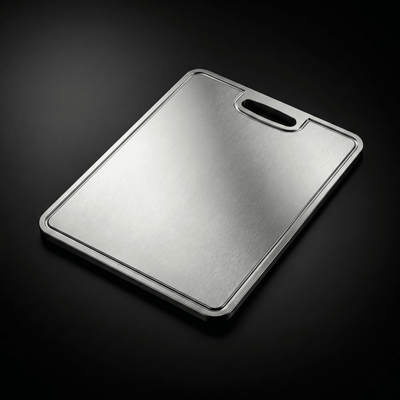
Solid titanium is the newest option and, on the three tests above, a strong one. It is one of the most biocompatible materials known — inert enough that it is used for medical implants — so it does not react with food, acids, or salt. Because it is solid metal with no coating, there is no film to wear off, no dye, and no adhesive. And because it is not plastic, a knife cannot score microplastics out of it into your food. It does not need oiling, it will not warp, and it does not absorb odours or colours the way a porous board can.
The honest trade-off is feel: titanium is harder than wood, so good technique and a sharp edge matter, and it will not have the soft give some cooks like under the blade. What you get in return is a surface that is easy to clean, does not hold bacteria in knife grooves, and stays chemically the same for its entire life.
Hygiene, in practice
Whatever material you choose, the hygiene rules are the same: keep separate boards for raw meat and for produce, wash thoroughly after each use, and replace any board once it is deeply scored and no longer cleans up properly. A non-porous surface makes that easier, because there are fewer places for bacteria to hide in the first place.
The bottom line
A non-toxic cutting board is one that stays inert, sheds nothing, and carries no finish that can migrate. Well-maintained solid wood qualifies. Solid titanium qualifies without the upkeep — no oiling, no microplastics, no coating to fail. If that is the standard you want, see our pure titanium cutting board.
The Cookware
Built to Last
Uncoated grade-1 titanium. No PFAS, no coatings, backed by a 25-year warranty.
Shop the Collection