



Titanium Safety
Pure Titanium Cookware: What It Is & Why It Matters
Pure titanium cookware is one of the most misunderstood terms in the kitchen, because the word "titanium" gets used to describe very different products. Some pans are solid titanium; others are aluminium or steel with a titanium-reinforced coating. The difference matters — a lot — for what ends up in your food. Here is what "pure" actually means and why it's worth insisting on.
What "pure titanium" means
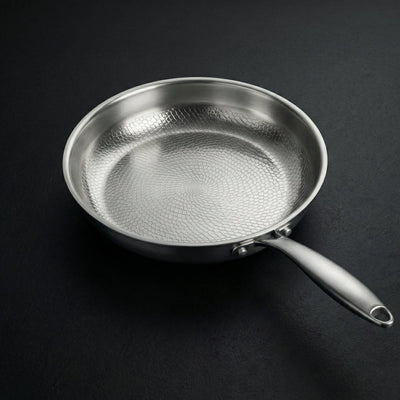
Pure, or solid, titanium cookware is made from titanium all the way through — the cooking surface is the metal itself, not a film applied on top. In practice, cookware-grade titanium is a high-purity grade of the metal (Okura uses 99.6% grade-1 titanium). There is no aluminium core, no steel base, and crucially no chemical non-stick layer between your food and the surface.
What it is often confused with
Several products borrow the titanium name without being solid titanium:
- Titanium-coated pans — usually aluminium with a non-stick coating that has titanium particles mixed in. The surface is still a coating, and it still wears out.
- Titanium-reinforced non-stick — the same idea, marketed harder. The titanium is in the coating, not the pan.
- Clad or "titanium" trim pans — where titanium is a minor layer or accent, not the cooking surface.
None of these are wrong to exist — but they are not solid titanium, and they behave like coated cookware because that's what they are.
If titanium is in the coating, you still have a coating. Solid titanium has nothing between your food and the metal.
Why solid matters for safety
The reason to care is simple. A coating can wear, flake, and release small amounts into your food — which is why coated pans get replaced every few years. Solid titanium has nothing to release. It carries no PFAS, PTFE, PFOA, lead or cadmium in the cooking surface because those were never part of the pan. The metal itself is biocompatible and inert, trusted for surgical implants meant to stay inside the body for decades. Our guide on whether titanium cookware is safe walks through the chemistry.
How pure titanium performs
Solid titanium isn't just a safety story — it cooks well and lasts. It's naturally non-stick with a properly pre-heated, lightly oiled surface. It's metal-utensil safe because there's no coating to scratch. It handles high heat without a coating's temperature ceiling and moves from induction to oven to open flame. And at roughly 45% lighter than stainless steel, it delivers that durability without the heft of cast iron. Because there's no coating on a replacement clock, a solid titanium pan can be backed by a 25-year warranty.
How to shop for it
When a pan is described as titanium, look past the headline:
- Confirm the cooking surface is solid titanium, not a titanium-infused coating.
- Check for a stated titanium grade or purity.
- Confirm it's metal-utensil safe — a coating usually isn't.
- Look for a long, honest warranty; solid titanium earns one, coatings can't.
The bottom line
Pure titanium cookware means solid titanium as the cooking surface — no coating, nothing to leach, nothing to flake. That's the version worth buying, and it's a different product from the titanium-coated pans that share the name. Explore solid titanium in our Japanese pans collection, each made from high-purity titanium and backed by a 25-year warranty.
The Cookware
Built to Last
Uncoated grade-1 titanium. No PFAS, no coatings, backed by a 25-year warranty.
Shop the Collection