



Japanese Knives
Santoku vs Chef Knife: What's the Difference
Ask what the difference between a santoku and a chef knife really is, and the honest answer is: less than the marketing suggests, but enough to matter. Both are all-purpose knives meant to handle the majority of your prep. Where they part ways is shape, length and the cutting motion each one is built around. Understand that, and choosing between them gets easy.
The short answer
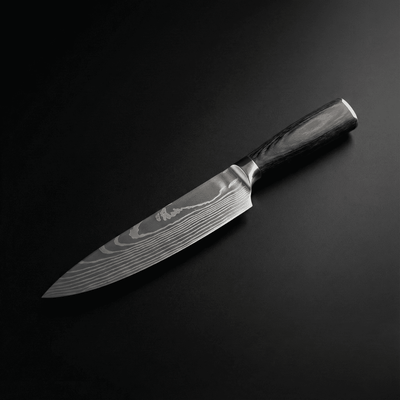
A chef's knife is longer, with a curved belly built for rocking cuts and a pointed tip for detail work. A santoku is shorter and flatter, built for straight up-and-down cutting and everyday control. The chef's knife trades some agility for reach and slicing power; the santoku trades some reach for lightness and precision. Both will get you through a full meal — the "right" one depends on how you like to move a blade.
The chef's knife: reach and rocking
The Western chef's knife is the default in most kitchens for good reason. Its curved edge is made to rock against the board — tip down, sweep the heel through — which is fast and efficient for mincing herbs, garlic and anything you want to run through quickly. The extra length gives you reach to slice large items and break down bigger cuts of meat, and the tapered point handles fine work. If you learned to cook on a chef's knife, its motion is already in your hands.
The santoku: control and clean cuts
The santoku comes at the same job from a Japanese perspective. It is shorter and lighter, with a mostly flat edge and a rounded tip. Instead of rocking, you cut straight down or push slightly forward, letting the full edge land on the board. That makes for clean, even slices and a knife that feels planted and easy to control. The lighter blade is quick to steer, which many cooks find more comfortable — especially for repetitive vegetable prep or in a smaller kitchen.
A chef's knife is built to rock and reach. A santoku is built to chop and control. Same job, two philosophies.
Blade shape and cutting style
This is the difference that actually changes how the knife feels. The chef's knife curve keeps the tip anchored so you can rock; a santoku's flat profile wants a lift-and-drop or push cut. Use each the way it is designed and both feel natural. Force a rocking motion on a santoku and it feels short and awkward; try to chop straight down with a long chef's knife and you lose some of its point. The blade shape, not the badge, is what you are really choosing between.
Weight, balance and feel
Chef's knives tend to be longer and a touch heavier, which some cooks read as authority and others as clumsiness. Santokus are shorter and lighter, which reads as nimble to some and slight to others. There is no universally correct answer — it is genuinely about your hand, your habits and the food you cut most. If you can, hold both before deciding; the one that disappears into your grip is the one to buy.
Which is right for you?
- Go with a chef's knife if you rock the blade, want reach, and regularly break down larger ingredients.
- Go with a santoku if you cut straight down, want a lighter and more controllable knife, or do a lot of vegetable prep.
- Own both if you cook often — a chef's knife for reach and a santoku for precision cover nearly everything between them.
Whichever shape suits you, the quality that matters is under the surface: the steel, the heat treatment and the edge. A well-made Japanese knife holds its sharpness and makes each cut feel lighter, which is what turns prep from a chore into something you look forward to. Explore the santoku knives collection to feel the difference, and see how every blade fits together in our guide to Japanese knife types.
The Cookware
Built to Last
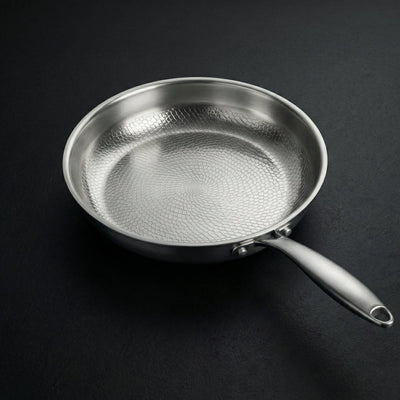
Uncoated grade-1 titanium. No PFAS, no coatings, backed by a 25-year warranty.
Shop the Collection