



Titanium Safety
Titanium Cookware Pros and Cons
Titanium cookware pros and cons deserve an honest accounting, not a sales pitch. Titanium has real advantages that other materials can't match, and a few trade-offs you should understand before you buy. Here is the straight version, so you can decide whether it fits the way you cook.
The pros
Start with what titanium does well, because the list is genuinely strong.
- Inert and non-toxic. Solid titanium is biocompatible — the same reasoning that has it trusted for surgical implants. It forms a stable oxide layer that keeps it from reacting with acids, salts, or the everyday chemistry of cooking.
- No coatings, nothing to leach. A solid titanium pan carries no PFAS, PTFE, PFOA, lead or cadmium in the cooking surface. There is no film to wear off into your food.
- Light for its strength. Titanium is roughly 45% lighter than stainless steel, so you get durability without the wrist strain of heavy cast iron.
- Metal-utensil safe. With no coating to protect, you can use metal tools without worrying about scratches.
- Induction to oven to flame. One pan moves across the whole kitchen, and it handles high heat without a coating's temperature ceiling.
- Built to last. There is no coating on a two-to-three-year replacement clock, which is why a solid titanium pan can be backed by a 25-year warranty.
The cons
No material is perfect, and titanium is no exception.
- Release is a technique, not a spray. Titanium is naturally non-stick when the pan is properly pre-heated and lightly oiled, but it does not behave like a freshly coated non-stick pan on day one. There is a short learning curve.
- Higher upfront cost. You pay more at the register than for a cheap coated pan — the trade being that you are not rebuying every few years.
- Heat tint appears. Cook on titanium a while and you may see a faint rainbow or bronze bloom. It is cosmetic, not a defect, but some people expect a surface that stays factory-shiny.
- Even heating rewards patience. Titanium wants a moment to come up to temperature. Rush it and you'll fight hot spots; pre-heat properly and it's even.
Most of titanium's "cons" are really a change in habit: pre-heat, use a little fat, and let the pan do the work.
Heat tint, explained
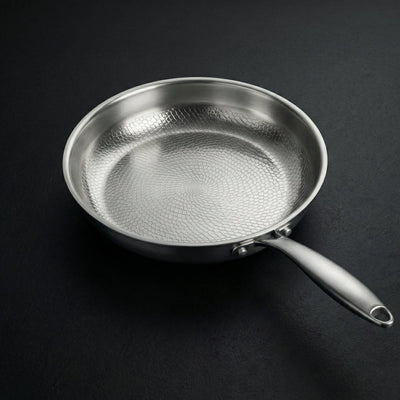
The rainbow tint worries first-time owners, so it's worth being clear. Heat tint is simply the oxide layer growing slightly thicker and bending light differently — the same effect on a well-used titanium bike frame or a surgeon's instrument tray. It is purely cosmetic. It does not mean a coating is failing, because there is no coating to fail. A little polish brings the shine back if it bothers you; if it doesn't, it's a sign the pan is doing its job.
Who titanium suits
Titanium makes the most sense if you cook regularly, care about what ends up in your food, and are tired of the replace-every-few-years cycle of coated pans. If you want the absolute cheapest pan today and don't mind buying another one soon, a budget coated pan will feel easier at first. If you want one honest pan that lasts, titanium is built for that. For the full safety reasoning behind the material, see our guide on whether titanium cookware is safe.
The bottom line
The pros — inert, coating-free, light, metal-utensil safe, oven-to-induction, and long-lasting — are structural advantages of the material itself. The cons come down to a short learning curve, a higher upfront price, and a cosmetic tint. For most people who cook often, that math favours titanium. Explore the range in our Japanese pans collection, each backed by a 25-year warranty.
The Cookware
Built to Last
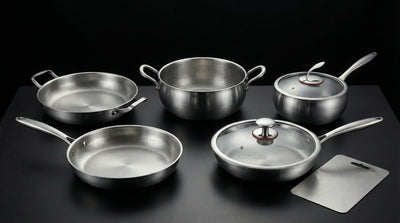
Uncoated grade-1 titanium. No PFAS, no coatings, backed by a 25-year warranty.
Shop the Collection