



Comparisons
Stainless Steel vs Titanium Cutting Board
If you have narrowed your search to a metal board, the stainless steel vs titanium cutting board question is the last one to settle. Both are non-porous, both shrug off the bacteria worries that come with grooved plastic and thirsty wood, and both will outlast almost anything else on your counter. But they are not the same tool, and the right pick depends on what you value once the marketing settles.
Why a metal cutting board at all?
Wood and plastic dominate most kitchens, and both share one weakness: they are porous. Every cut leaves a micro-groove that can hold moisture, juices and bacteria, and plastic boards in particular develop deep knife scars over time. A metal board is the opposite — a sealed, non-absorbent surface you can scrub, sanitise with boiling water, and never worry about soaking through. That hygiene is the whole reason to consider one. It is also the honest trade-off: any hard metal surface is less forgiving on a knife edge than end-grain wood, so a metal board suits a cook who keeps their knives sharp.
Stainless steel cutting boards
Stainless steel is the familiar, budget-friendly metal option, and its strengths are straightforward. It is completely non-reactive, dishwasher-safe, heat-proof, and it will not absorb odours from garlic, onion or fish. Professional kitchens have used steel prep surfaces for decades for exactly these reasons.
Where stainless falls short is in the details. It is heavy, it can be noisy and slippery under the knife, and thinner boards flex or dent. It also shows scratches and water spots readily, and — depending on the grade — cheaper stainless can pit or discolour over time. None of this makes it unsafe; it simply makes it a workhorse rather than a centrepiece.
Titanium cutting boards
Titanium shares every hygiene advantage of stainless and adds the properties the metal is prized for elsewhere. It is inert and non-toxic — the same biocompatible metal used for surgical implants — with no coating and nothing to leach into food. It is corrosion-proof, so it will not rust, pit or stain the way some steel can. And it is markedly lighter: around 45% lighter than a comparable stainless board, which matters more than you would expect when you lift it to scrape prep into a pan or carry it to the sink.
The honest limits: titanium sits at a premium price, and like all metal boards it is a hard surface. It keeps your knives clean and your board pristine, but it will dull an edge faster than a soft wooden board would. That is a fair trade if hygiene and permanence are what you are buying.
Any hard surface, steel or titanium, is tougher on a fine edge than end-grain wood. Choose a metal board for hygiene and longevity — and keep a whetstone within reach.
Do metal boards dull your knives?
This is the most common objection, and it deserves a straight answer: yes, a metal board is harder on your edge than wood or a soft polymer, and neither stainless nor titanium changes that. The upside is that a sharp knife on a clean, flat metal surface still cuts cleanly, and the fix is not exotic. A quick pass on a honing rod between uses and an occasional session on a whetstone keeps any knife performing — a small habit next to the payoff of a board that never harbours bacteria and never needs replacing. If you cook with thin-bladed Japanese knives every day, many cooks keep a wooden board in rotation too, and reach for the metal board when hygiene matters most, such as raw meat and fish.
Which should you choose?
It comes down to priorities:
- Choose stainless steel if upfront price is the deciding factor and you want a proven, no-fuss prep surface.
- Choose titanium if you want the lightest metal board, guaranteed corrosion resistance, a fully inert surface, and a board you will genuinely keep for decades.
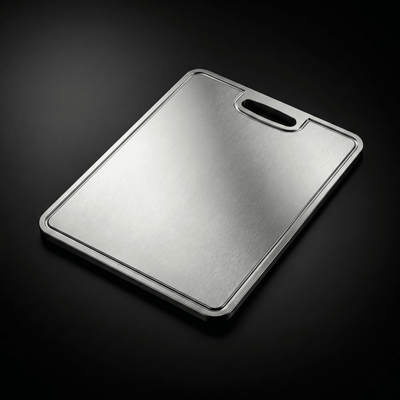
If longevity is the goal, titanium is the more future-proof of the two. See how it is built in the pure titanium cutting board, and if you are still weighing materials more broadly, our best cutting board buyer's guide lays out wood, plastic and metal side by side.
The Cookware
Built to Last
Uncoated grade-1 titanium. No PFAS, no coatings, backed by a 25-year warranty.
Shop the Collection