



Comparisons
Best Cutting Board: 2026 Buyer's Guide
There is no single best cutting board — there is the best board for how you cook, what you value, and how much upkeep you are willing to do. The honest truth is that every material trades one strength for another: the surface that is kindest to your knives is the one that needs the most care, and the one you can throw in the dishwasher is the one that dulls a blade fastest. This guide walks through the criteria that actually matter, then compares wood, bamboo, plastic, and titanium straight — so you can pick the board that fits your kitchen rather than the one with the loudest marketing.
How to choose a cutting board: the five criteria that matter
Ignore the aesthetics for a moment and judge any board on five things:
- Knife-friendliness. How hard is the surface? Softer surfaces let the edge sink in slightly and spring back, preserving sharpness; harder surfaces dull and can chip an edge over time.
- Hygiene and porosity. Can the surface absorb moisture, juices, and bacteria into its structure, or does it stay sealed? This matters most for raw meat, poultry, and fish.
- Maintenance. Does it need oiling, careful drying, and hand washing — or can you rinse it and forget it?
- Durability. Will it crack, warp, stain, hold odours, or wear out, and how soon?
- Size, weight, and stability. A board that slides or is too small to work on is a safety problem, whatever it is made of.
No material scores top marks on all five. The right board is the one whose trade-offs you are happy to live with.
Wood: the classic, and still the benchmark for knives
A quality hardwood board — maple, walnut, cherry, or teak — is what most chefs reach for, and for good reason: wood is the kindest surface there is to a knife edge. It has a slight give that cushions the blade, and end-grain boards (where the wood fibres face up like the top of a butcher's block) are gentler still, because the edge slips between the fibres rather than across them. Wood also has a mild natural resistance to bacteria.
The trade is maintenance. Wood is porous, so it must be hand washed, dried promptly, and never left soaking or put in the dishwasher — all of which will crack or warp it. It also needs regular oiling to stay sealed and sound. Do that, and a good board lasts decades; skip it, and it splits. If you choose wood, our guide to cutting board oil covers keeping it in shape.
Bamboo: light, hard, and eco-friendly — with a catch
Bamboo is technically a grass, and it makes a hard, lightweight, sustainable board that is more water-resistant than most woods and usually cheaper. It is a solid all-rounder for everyday chopping and looks good doing it.
The catch is in that hardness: bamboo is firmer than hardwood, so it is a little tougher on knife edges. It is also glued together from strips, and the glue lines are where cheap bamboo boards split if they are soaked or run through a dishwasher. Treat it like wood — hand wash, dry upright, oil occasionally — and it serves well; our guide on how to clean a bamboo cutting board has the routine.
Plastic: cheap and dishwasher-safe, but wears fast
Plastic (usually HDPE) boards are inexpensive, lightweight, dishwasher-safe, and easy to colour-code for raw meat versus produce. For years they were considered the hygienic default. But there is a real drawback that has come into focus: knives carve permanent grooves into plastic, and those knife scars are hard to clean, harbour bacteria, and shed microplastics into food as the surface degrades. A scored, stained plastic board is not a hygienic board — and plastic dulls knives faster than wood does. They are cheap to replace, which is both the appeal and the tell: plastic boards are consumables.
Every cutting board is a trade-off between three things: your knives, your hygiene, and your time. No material wins all three — so decide which one you care about most.
Titanium: non-porous and zero-maintenance, but firm underfoot
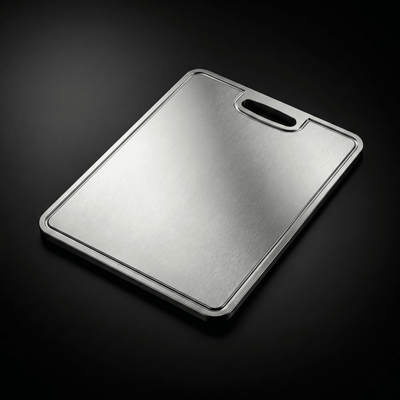
A solid titanium board is the opposite of wood in almost every way, and that is precisely its appeal. Because it is non-porous metal, nothing soaks in: no absorbed juices, no bacteria driven into the grain, no stains, and no retained odours. It will not crack, warp, or split; it needs no oiling; and it can go straight in the dishwasher. Titanium is also inert and free of PFAS, PTFE, lead, and cadmium, so there is nothing in the surface to worry about — and unlike plastic, it does not degrade into your food or need replacing on a cycle. For raw-protein prep and for anyone who simply does not want a maintenance ritual, it is a genuinely low-effort, hygienic surface.
Here is the honest trade: metal is firmer than wood, so a titanium board does not cushion an edge the way an end-grain block does — wood remains the gentlest choice for pure knife-friendliness. Titanium is, however, far kinder to blades than glass, stone, marble, or ceramic, which are so hard they chip edges and should generally be avoided as cutting surfaces. Many cooks who choose titanium pair it with regular honing and are happy to trade a little edge-cushioning for a board that is effectively indestructible and needs nothing from them.
Which cutting board should you buy?
Match the board to what you value most:
- You care most about your knives: a large end-grain hardwood board, and commit to the oiling.
- You want a good-value daily board: bamboo or edge-grain hardwood, maintained properly.
- You want the lowest maintenance and best hygiene, and will hone your knives: a solid titanium board — non-porous, dishwasher-safe, and built to last.
- You need cheap, colour-coded boards and do not mind replacing them: plastic, swapped out once they are scored.
Many kitchens end up with two: a wooden board for everyday chopping and a non-porous board for raw meat. That covers the knife-friendliness and hygiene priorities at once.
The bottom line
The best cutting board is the one whose trade-offs suit you. Wood wins on knife-friendliness and asks for maintenance in return. Titanium wins on hygiene and durability and asks you to hone a little more often. Plastic is cheap and disposable; glass and stone are best kept off the chopping list entirely. Decide which of the five criteria you weigh heaviest, and the choice gets easy.
Ready to choose? Browse our full range of cutting boards, or see the maintenance-free option in detail — the pure titanium cutting board.
The Cookware
Built to Last
Uncoated grade-1 titanium. No PFAS, no coatings, backed by a 25-year warranty.
Shop the Collection