



Japanese Knives
What Is a Nakiri Knife Used For?
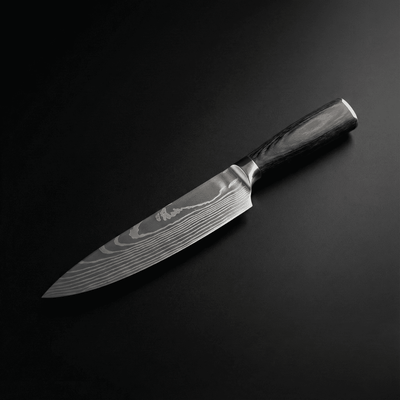
The question of what a nakiri knife is used for has a refreshingly simple answer: vegetables — slicing, dicing and chopping produce quickly and cleanly. But that one line hides real range, so let us look at exactly what the nakiri does well, what it is not for, and how to get the most from it.
The short answer
A nakiri is a Japanese vegetable knife, and vegetable prep is its whole purpose. Its straight, flat edge is built to push straight down through produce and meet the cutting board cleanly along the blade's full length. That makes it fast and precise on everything from onions to leafy greens — the jobs that make up most of the chopping in a home kitchen.
What it handles beautifully
- Slicing — clean, even cuts through carrots, cucumbers, courgettes and similar vegetables.
- Dicing — work an onion or pepper down to an even dice without the pieces tearing or clinging together.
- Fine julienne and shredding — the tall, flat blade makes thin, consistent cuts straightforward.
- Chopping herbs and greens — a stack of leaves goes through in a single clean push.
- Scooping — the broad blade face lifts prepped vegetables straight to the pan.
The nakiri does one family of jobs — vegetables — and does them cleaner and faster than a curved blade can.
How to use it well
The nakiri rewards a simple technique: lift the blade and push it straight down, letting the flat edge do the work, rather than rocking it the way you would a curved chef's knife. Because the whole edge meets the board at once, you get a complete cut in one motion — no sawing back and forth. Keep your guiding hand in a loose claw, let the tall blade rest against your knuckles, and you can work quickly and safely.
What it is not for
A nakiri is a specialist, and knowing its limits keeps it sharp. It is not meant for carving meat, cutting through bones, piercing or boning, or rock-chopping the way a curved blade does. For those jobs, reach for a versatile chef's knife or the right specialist instead. Used inside its lane, the nakiri is hard to beat.
How it compares to a chef's knife
A chef's knife (or its Japanese cousin, the gyuto) is the versatile all-rounder; the nakiri is the vegetable expert. They are complements, not rivals. Many cooks keep a versatile main knife for proteins and mixed prep and reach for the nakiri whenever the board fills with vegetables. To see where it sits among the other shapes, our Japanese knife types guide lays them all out, and our nakiri knife guide goes deeper on the blade itself.
The bottom line
A nakiri knife is used for vegetables — and within that job it is fast, clean and genuinely satisfying to use. If you cook plenty of produce, it will quickly become the knife you reach for most. Find yours in our chef's knives collection, each backed by a 25-year warranty.
The Cookware
Built to Last
Uncoated grade-1 titanium. No PFAS, no coatings, backed by a 25-year warranty.
Shop the Collection